NVIDIA Vera Rubin POD:七颗芯片、五套机柜级系统、一台 AI 超级计算机 — 英伟达 Vera Rubin 机柜级 AI 超算平台详解
NVIDIA 官方技术博客对 Vera Rubin POD 的架构全景解读:七类芯片(Rubin GPU、Vera CPU、ConnectX-9、BlueField-4、NVLink 交换机、Spectrum-6、Groq 3 LPU)协同、五套机柜级系统、第三代 MGX 机柜的供电/散热/可维护性创新,以及 Spectrum-6 交换机集成 200Gb/s 共封装光学(CPO)对光互联投资主线的印证。含 12 张官方原图本地落地。
来源:NVIDIA Technical Blog(作者 Rohil Bhargava、Taylor Allison、Harry Petty)|原文发布:2026-03-16|全文公开,无付费墙 本文按本站「光投资系列」同款格式发布:第一部分为英文原文(逐字转载,含 12 张官方原图,已下载落地至本站
/assets/img/),第二部分为中文深度解读。 ⚠️ 立场说明:原文为 NVIDIA 官方技术/营销口径,文内 10x / 35x / 5x 等性能与能效倍数均为厂商自述,深度解读部分已做去营销化处理并标注需第三方验证之处。图片版权归 NVIDIA 所有,仅作技术解读引用。
第一部分:正文(Original Article)
Artificial intelligence is token-driven. Every prompt, reasoning step, and agent interaction generates tokens. Over the past year, token consumption has grown multifold and now exceeds 10 quadrillion tokens per year. And while the majority of tokens have been generated from humans interacting with AI, the new era is one in which most tokens will be generated from AI interacting with AI.
Modern agentic systems plan tasks, invoke tools, execute code, retrieve data, and coordinate across continuous multistep workflows with numerous AI agents. These interactions generate large volumes of reasoning tokens, expand KV cache, and require CPU-based sandboxed environments to test and validate results generated by accelerated computing systems. This places low latency, high throughput demands across GPUs, CPUs, scale-up domains, scale-out networks, and storage.
Delivering useful intelligence for these modern agentic systems requires fleets of purpose-built rack-scale systems that function together as one coherent AI supercomputer. This post introduces the NVIDIA Vera Rubin POD, a set of five specialized rack-scale systems built on the third-generation NVIDIA MGX rack architecture for the era of agentic AI.
Introducing NVIDIA Vera Rubin POD
Built through extreme co-design of seven chips spanning compute, networking, and storage, NVIDIA Vera Rubin introduces the most sophisticated POD-scale AI platform. The platform features 40 racks, 1.2 quadrillion transistors, nearly 20,000 NVIDIA dies, 1,152 NVIDIA Rubin GPUs, 60 exaflops, and 10 PB/s total scale-up bandwidth.
The Vera Rubin POD introduces five new distinct purpose-built rack-scale systems for agentic AI workloads that require high throughput, extreme low-latency inference, dense CPU sandboxing, and massive context memory storage. Together, these racks form one cohesive system that will power the world’s most energy- and cost-efficient data centers.
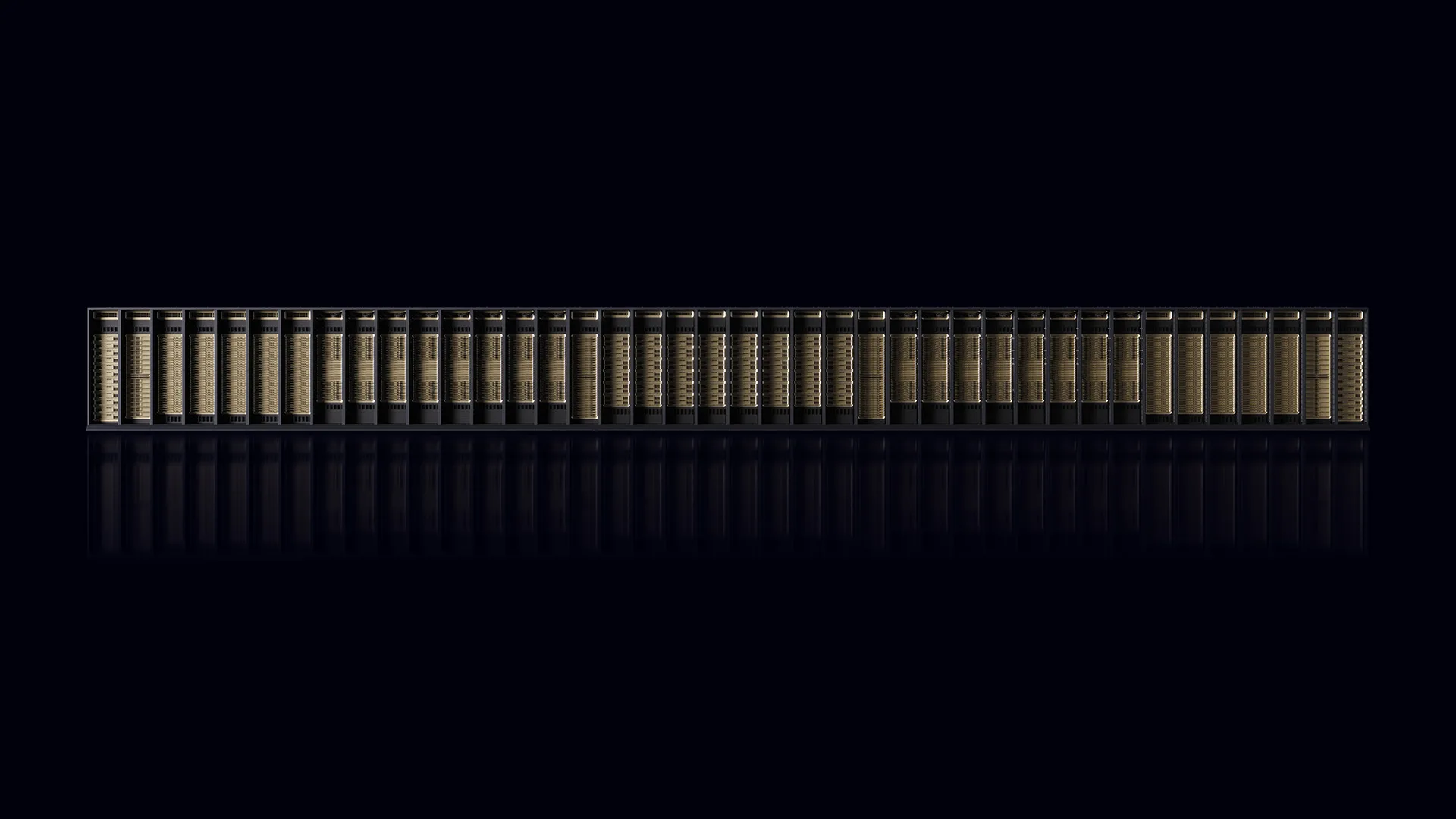
Each chip in the POD scales with a third-generation NVIDIA MGX rack, supported by an ecosystem of more than 80 partners with a global supply chain experienced in bringing large-scale AI systems to market. This enables fast deployments and seamless transitions with each NVIDIA MGX rack sharing the same power, cooling, and mechanical envelopes.
There are two types of MGX racks with copper spines designed for performance, resiliency, and energy efficiency. The MGX NVL rack is connected by NVIDIA NVLink, and the new NVIDIA MGX ETL rack is connected by one of two types of spines: NVIDIA Spectrum-X Ethernet or NVIDIA Groq 3 LPU direct chip-to-chip links.
NVIDIA Vera Rubin NVL72: Platform for the four scaling laws
NVIDIA Vera Rubin NVL72 is the core rack-scale compute engine of the latest AI factory. Integrating 72 NVIDIA Rubin GPUs and 36 NVIDIA Vera CPUs connected through a massive NVLink copper spine, it acts as a one giant GPU. NVIDIA Vera Rubin NVL72 is designed for the four scaling laws of AI: pretraining, post-training, test-time scaling, and agentic scaling. It can be optimized for complex mixture-of-experts (MoE) routing, and the heavy compute-bound context phase of AI inference. It delivers up to 4x better training performance and up to 10x better inference performance per watt, and one-tenth the token cost relative to NVIDIA Blackwell.
NVIDIA Groq 3 LPX: Inference accelerator racks
Co-designed with the NVIDIA Vera Rubin platform for the massive context and low-latency demands of agentic AI, NVIDIA Groq 3 LPX features 256 language processing units (LPUs) per rack. It pairs with Vera Rubin NVL72 to eliminate the tradeoff between high-speed interactivity and throughput. By fusing high-bandwidth SRAM-only LPUs with Rubin GPUs with large HBM capacity, the system delivers low latency and high throughput at long context lengths—supercharging user interactivity for trillion-parameter models without sacrificing system throughput. Vera Rubin NVL72 plus LPX delivers up to 35x more tokens and up to 10x more revenue opportunity for trillion-parameter models relative to Blackwell.
NVIDIA Vera CPU rack: Agentic AI and reinforcement learning at scale
The NVIDIA Vera CPU rack integrates up to 256 NVIDIA Vera CPUs in a dense, liquid-cooled rack to provide scalable, energy-efficient capacity. A single rack can sustain over 22,500 concurrent reinforcement learning (RL) or agent sandbox environments, maximizing environments to test, execute, and validate results from the Vera Rubin NVL72 and LPX racks. Vera CPU racks provide the foundation for large-scale agentic AI and reinforcement learning, delivering results twice as efficient and 50% faster than traditional rack-scale CPUs.
NVIDIA BlueField-4 STX: AI-native storage
The NVIDIA BlueField-4 STX rack is built with the NVIDIA BlueField-4 processor, which combines the Vera CPU and ConnectX-9 SuperNIC, and scales out with Spectrum-X Ethernet networking.
It hosts the NVIDIA CMX context memory storage platform, a new class of AI-native storage infrastructure that seamlessly extends GPU context capacity across the POD and accelerates inference by offloading KV cache into a dedicated, high-bandwidth storage layer. CMX is optimized to store and serve massive context memory (KV cache), treating temporary inference context as an AI-native, shared data type that can be reused across turns, sessions, and agents. This delivers up to 5x higher tokens-per-second and up to 5x better power efficiency than traditional storage approaches.
NVIDIA Spectrum-6 SPX: Networking racks
Connecting the entire POD into a single supercomputer are the NVIDIA Spectrum-6 SPX networking racks. The Spectrum-6 SPX networking rack is engineered to accelerate east-west and north-south traffic across AI factories. Configurable with either Spectrum-X Ethernet or NVIDIA Quantum-X800 InfiniBand switches, it delivers low-latency, high-throughput rack-to-rack connectivity at scale.
The Spectrum-6 SPX rack now includes the 102.4 Tb/s Spectrum-6 switch, which features 512 lanes and 200 Gb/s co-packaged optics (CPO) in single- and multi-chip switch offerings. This silicon photonics integration replaces pluggable transceivers, delivering highest power efficiency and resiliency, low latency and jitter, and nearly perfect effective bandwidth for keeping AI workloads across compute and storage environments perfectly synchronized.
By co-designing these purpose-built racks to operate as one, the Vera Rubin POD is positioned to accelerate every component of agentic AI workloads. This begins with the streamlined NVIDIA MGX rack design that forms the foundation of every rack in the POD.
Third-generation NVIDIA MGX rack-scale architecture
Production-grade AI racks must excel across several critical areas: rapid time to volume, proven performance at scale, deep hardware-software co-design, resiliency and energy efficiency, seamless data center deployment and logistics, readiness for future architectures, and more.
The third-generation NVIDIA MGX rack-scale architecture sets the standard across all categories with engineering breakthroughs integrated throughout its mechanical, power, and cooling design.
Enabling resiliency and scalability
The NVIDIA MGX rack prioritizes PCB-based connections with its single-wide design. It unlocks completely modular, cable-free, hose-free, and fanless compute and NVLink switch trays enabling maximum reliability, scalability and serviceability. Single 19-inch-wide racks also simplify shipping and logistics accelerating deployment across AI factories.
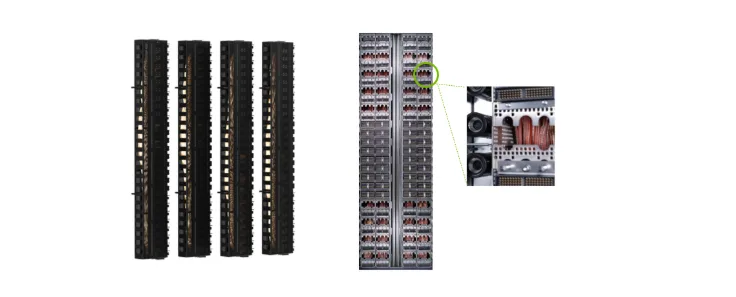
The rack features a highly modular spine as its backplane, consisting of up to four preintegrated and prevalidated copper cable cartridges that connect each tray as one. The spine holds thousands of cables and shares the same mechanical form factor for both MGX NVL and MGX ETL racks.
Ensuring peak energy efficiency from chip to grid
At the component level, the NVIDIA MGX racks feature dynamic power steering where the systems provision power to the components that need it most. This feature can move power between the CPUs, GPUs, and NVLink switch trays to ensure components in the rack operate at peak energy efficiency, improving performance per watt.
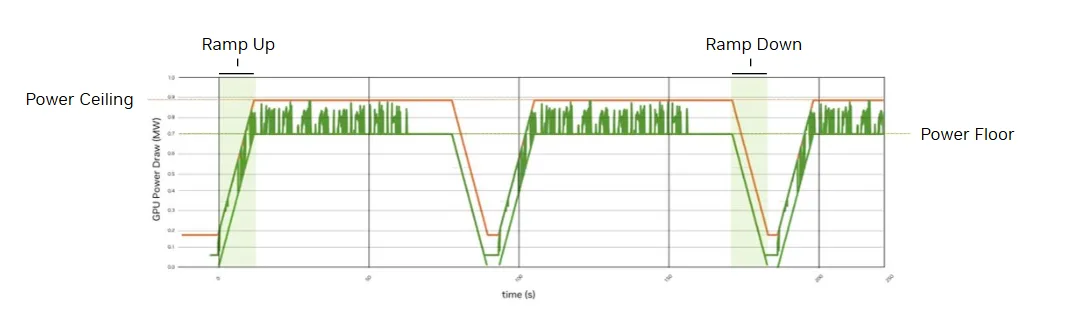
AI training and inference workloads create large load swings. If not managed effectively, load swings can cause significant stress on the electrical grid, data center power infrastructure, and IT equipment.
To protect against power swings, MGX racks feature rack-level energy storage that cushions power transients with capacitors. When workloads demand lots of power at once, the capacitor will supply the additional power while the grid power draw remains flat or ramps up. When workloads suddenly stop, the capacitor will charge while the grid power remains flat or ramps down.
NVIDIA Vera Rubin NVL72 now introduces Intelligent Power Smoothing. It features 6x more rack-level energy storage (400 J per GPU) versus prior generations, and introduces a new closed-loop system that enables the GPUs to continuously monitor the state of charge of the capacitors to more efficiently flatten power profiles. This achieves much smaller AC power variation per minute and reduces peak current demands by up to 25% to protect against sub-second large-scale power transients.
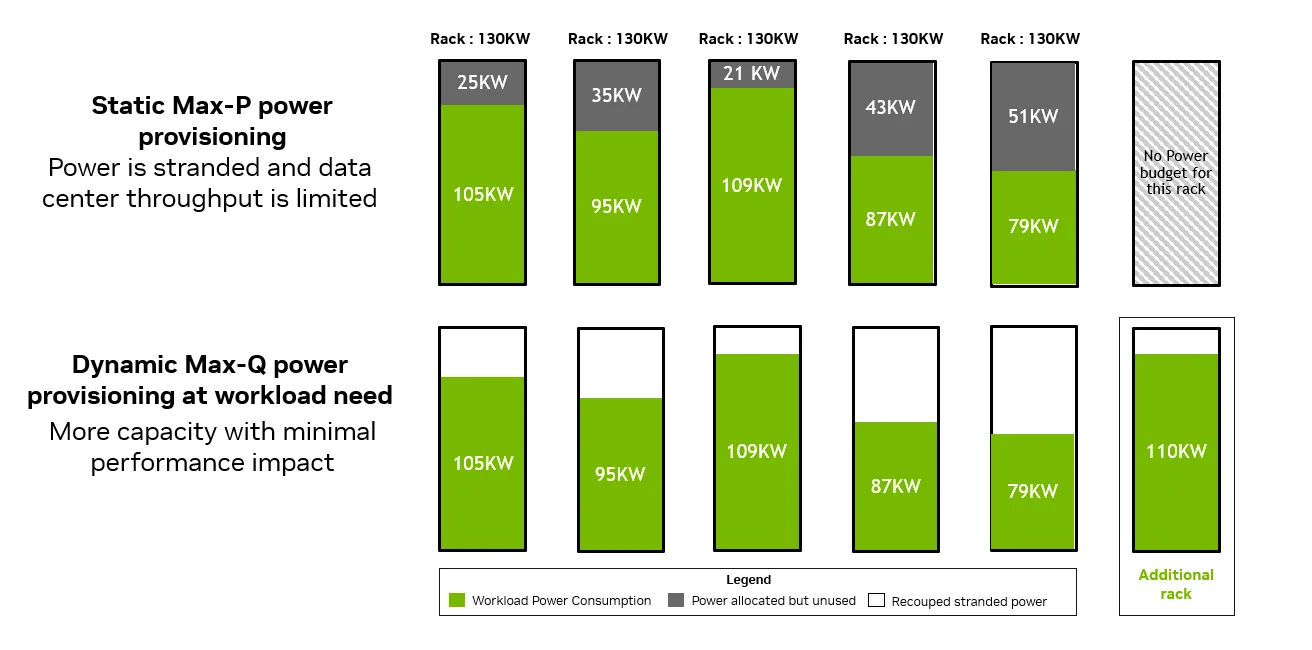
At the facility level, provisioning racks at static Max-P strands power capacity that could otherwise be used to generate tokens. It assumes homogeneous workloads that always require peak power, when in reality AI factories run a mix of workloads with varying power needs.
By provisioning MGX racks at a lower dynamic Max-Q level, data centers can maximize AI data center throughput by dynamically provisioning the correct amount of power to each rack depending on the workload. This frees up stranded power, unlocks up to 30% more GPUs in the same power budget with 45°C liquid cooling, and boosts performance per watt.
Unlocking larger energy budgets for compute
All MGX racks are universally designed to operate with 45°C (113°F) warm-water inlet temperatures so data centers already designed for liquid cooling are guaranteed a seamless transition without redesigning cooling infrastructure. Figure 5 shows a schematic representation of infrastructure layout to provide 41°C (105.8°F) water to coolant distribution units (CDUs) that in turn supply coolant at 45°C (113°F) to AI racks.
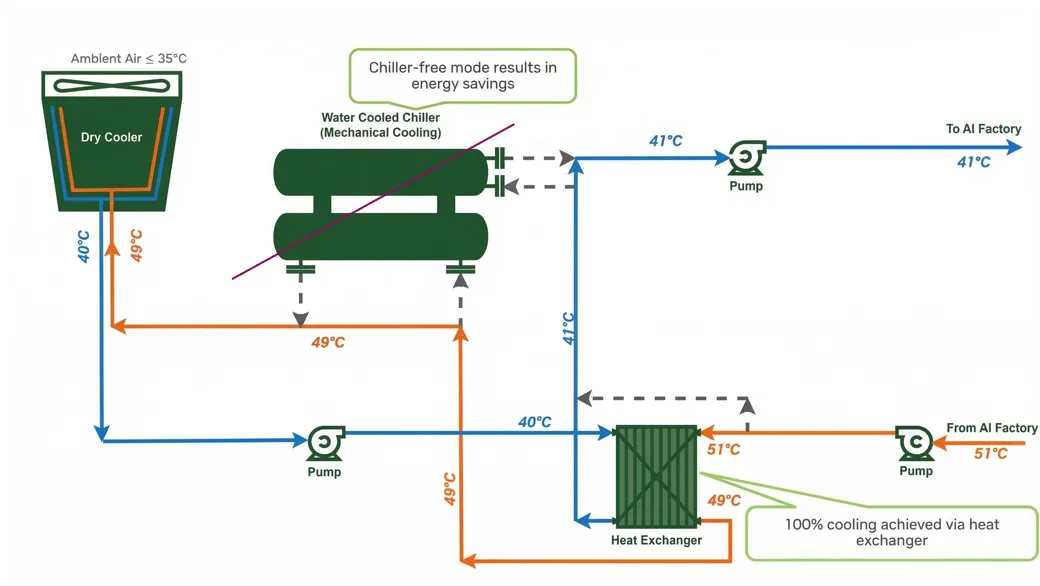
Operating at 45°C enables data centers in many climates to use ambient air and closed loop dry coolers for cooling, reducing the need for compressors, driving down PUE, and unlocking larger energy budgets for compute. Lower inlet temperatures of 35°C require data centers to divert massive amounts of facility power or water for cooling, while higher inlet temperatures maximize the amount of grid power converted directly into tokens. This yields significant data center power savings—enough to allocate up to 10% additional Vera Rubin NVL72 racks for more token generation in the same power budget.
MGX racks can be 100% liquid-cooled leveraging the same data center cooling infrastructure as prior generations. The third-generation MGX rack features new internal tray manifolds, rack UQD08 manifolds, and liquid cooled busbars supporting up to 5,000 A. The coolant used for the rack will depend on the customer and data center, but many will continue to use de-ionized water or propylene glycol-based fluid (PG25), which can last up to 10 years in a closed loop system with minimal liquid maintenance.
Open standard
Underpinning these features is an open, standardized MGX rack architecture. The first mass-production rack-scale system was with NVIDIA Blackwell in 2024. NVIDIA contributed the design to the Open Compute Project (OCP), reinforcing the commitment to open source technologies and enabling the entire ecosystem to rapidly innovate and accelerate adoption. NVIDIA has built an ecosystem of more than 80 global partners, creating a highly efficient, globally diversified supply chain that is experienced in bringing rack-scale AI systems to market.
NVIDIA MGX NVL racks
As independent third-party SemiAnalysis InferenceMax benchmarks demonstrate, NVIDIA rack-scale systems deliver 50x better performance per watt and 35x lower cost per token (NVIDIA GB300 NVL72 versus NVIDIA H200), which translates directly into higher revenues and better operating margins.
In 2024, NVIDIA shipped the first NVIDIA GB200 NVL72 rack-scale systems. In 2025, NVIDIA GB300 NVL72 was shipped. Now, NVIDIA Vera Rubin NVL72 is in full production, on track to ship in the second half of 2026.
Streamlined design of NVIDIA Vera Rubin NVL72
NVIDIA Vera Rubin NVL72 is an engineering marvel designed to drop seamlessly into existing data center footprints. It will feature nearly two times more transistors than NVIDIA GB200 NVL72 while delivering 10x more performance per watt through extreme co-design. The rack integrates 72 NVIDIA Rubin GPUs, 36 NVIDIA Vera CPUs, ConnectX-9 SuperNICs, and BlueField-4 DPUs across 18 compute trays, alongside 9 NVLink switch trays. In total, the rack houses 1.3 million individual components, nearly 1,300 chips, all packed into a single-wide third-generation NVIDIA MGX rack weighing roughly 4,000 lbs, or about the weight of a pickup truck.
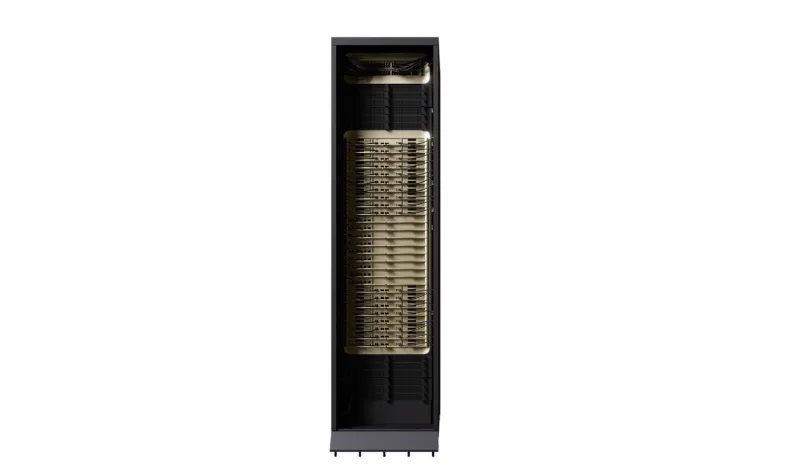
Compute and NVLink Switch trays
Enabling these 72 GPUs to act as a single unified engine is the sixth-generation NVLink. It delivers 3.6 TB/s of bandwidth per GPU and 260 TB/s of scale-up bandwidth per rack—more data than the bandwidth of the entire global internet. This high-speed data transfer happens in the NVLink spine at the back of the rack, which features four modular preintegrated cable cartridges housing 5,000 copper cables over two miles in length.
Video 1. Key differences between the NVIDIA Vera Rubin compute tray and the NVIDIA Grace Blackwell compute tray
The compute trays inside the Vera Rubin NVL72 are completely redesigned from NVIDIA Blackwell. It features a robust PCB midplane designed to fit in a single-wide rack that unlocks a cable-free, hose-free, and fanless design. This simplification drops compute tray assembly time from nearly two hours to just five minutes—up to 20x faster assembly and serviceability.
Each compute tray features two NVIDIA Vera Rubin superchips with 17,000 components each—approximately five times as many components as a modern smartphone. The superchips are connected to the front modular bays that house eight ConnectX-9 SuperNICs and one BlueField-4 DPU through the PCB midplane.
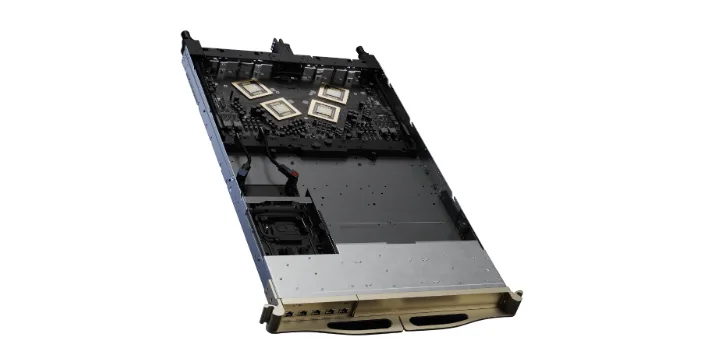
Vera Rubin NVL72 introduces new rack-scale resiliency features designed to maximize uptime and goodput for large AI clusters. The NVLink switch trays support operational resiliency features that allow administrators to place switches into maintenance mode and replace them while the rack continues operating. The architecture also supports continued operation even if multiple switch trays are unavailable, minimizing disruption during maintenance.
At the silicon level, NVIDIA Rubin GPUs continuously run nondisruptive health checks and NVIDIA Vera CPUs feature in-system testing and SOCAMM memory for faster serviceability. Together, these chip-to-rack innovations reduce operational overhead and build on the resiliency improvements seen with Blackwell clusters.
NVIDIA Vera Rubin Ultra NVL576
NVIDIA Vera Rubin Ultra introduces a new two-layer all-to-all NVLink topology that will enable developers to scale-up to 576 GPUs. Vera Rubin Ultra NVL576 will combine eight separate MGX NVL racks, each with 72 Rubin Ultra GPUs, all in a single 576-GPU NVLink domain with copper and direct optical connections. It will be built using the same MGX rack-scale ecosystem for fastest time to production.
Demonstrating this massive multirack NVLink topology, Polyphe is the NVIDIA internal fully functional GB200-based prototype of the multirack NVL576 scale-up architecture.
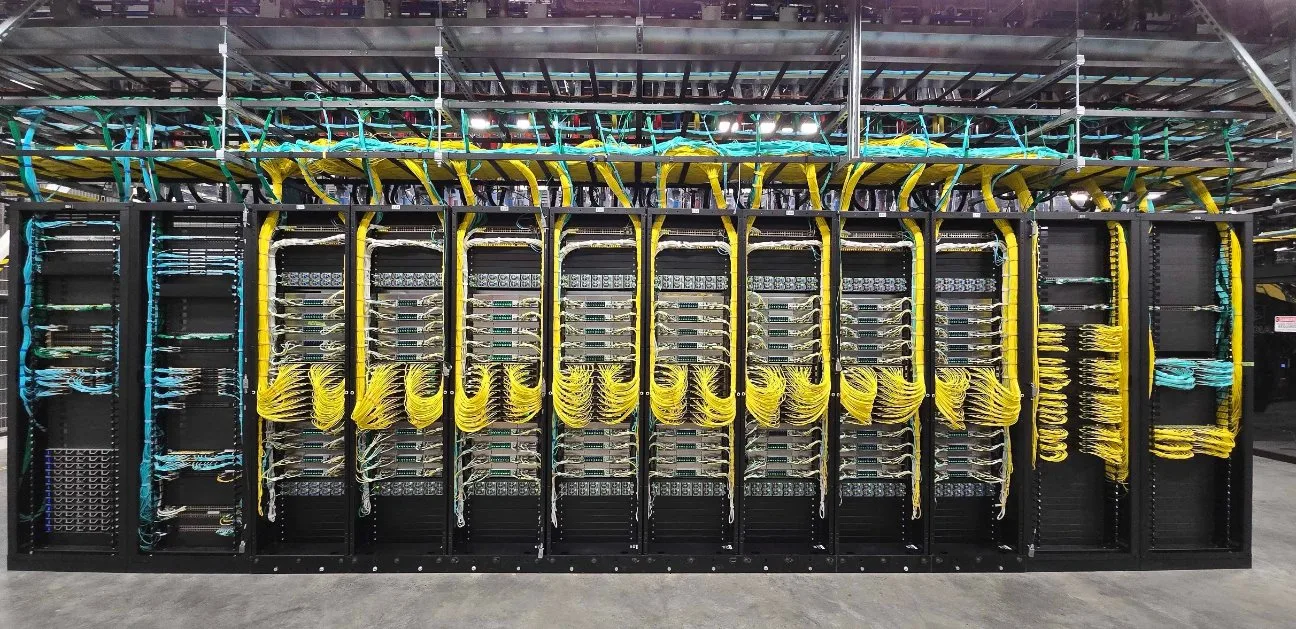
NVIDIA Kyber NVL1152: The next generation
To scale beyond NVL576, a new MGX rack, NVIDIA Kyber, will be introduced. NVIDIA Kyber is the next-generation MGX NVL rack design that will double the NVLink domain per rack to fit 144 GPUs.
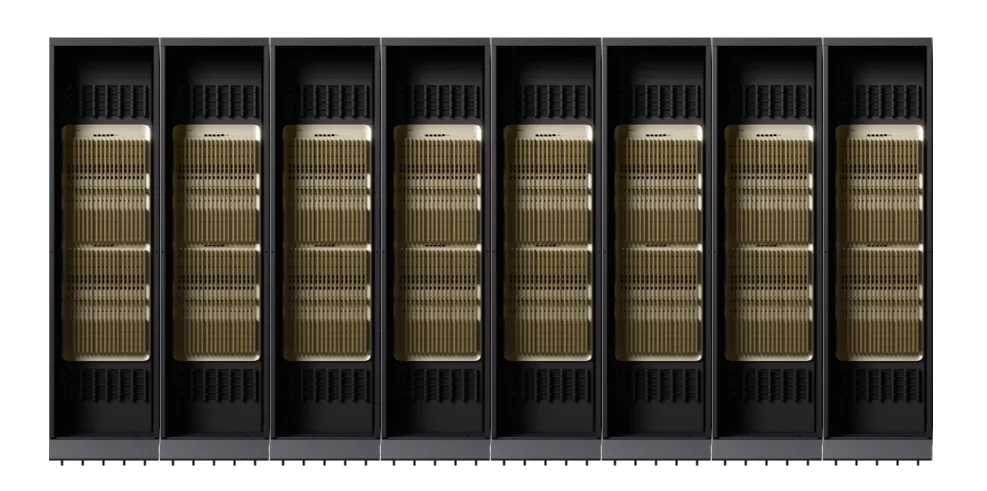
NVIDIA Kyber will scale up into a massive all-to-all NVL1152 supercomputer using similar direct optical interconnects for rack-to-rack scale-up. Kyber provides the foundation for the next era of extreme scale-up AI computing using NVIDIA Feynman. Kyber will first be introduced with Vera Rubin Ultra as a standalone NVL144 system, providing customers with three options for Vera Rubin Ultra NVLink scale-up domains: NVL72, NVL144, and the flagship NVL576.
NVIDIA MGX ETL racks
While NVIDIA MGX NVL racks provide massive scale-up compute domains, agentic AI workflows demand highly specialized nodes for extreme low-latency inference, CPU sandboxing, and accelerated context memory for KV cache. To support these diverse needs, Vera Rubin introduces the MGX ETL rack architecture, a new fully configurable MGX rack designed with a Spectrum-X Ethernet spine or a direct chip-to-chip spine leveraging the same rack-scale ecosystem as MGX NVL racks.
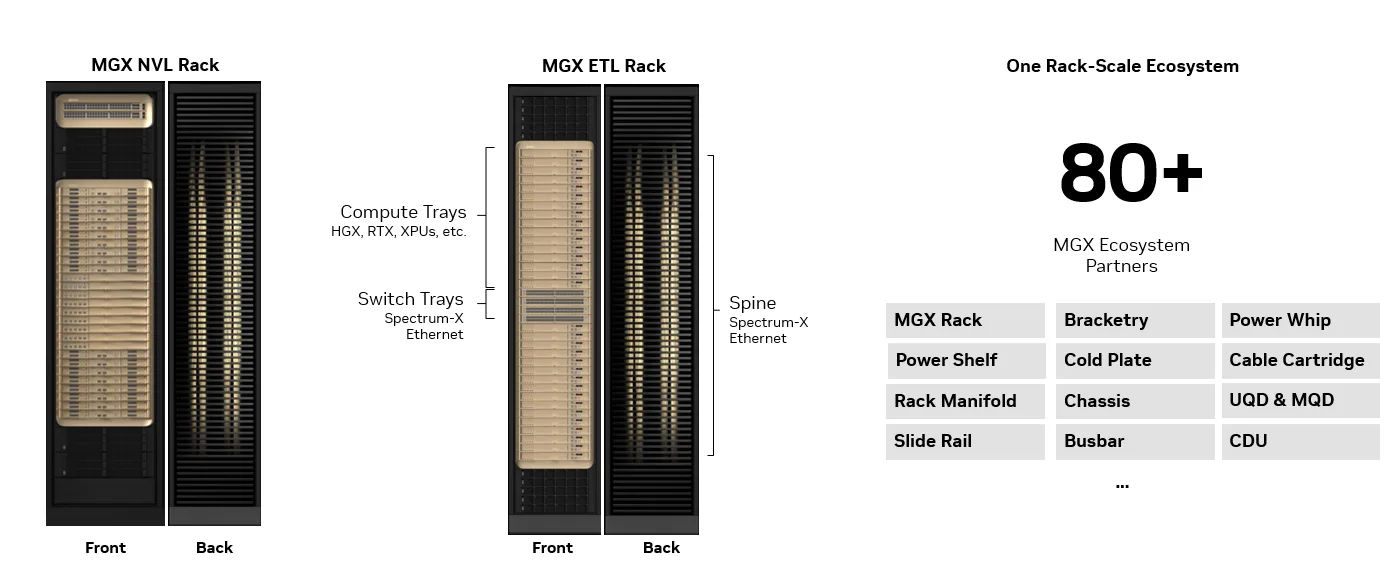
MGX ETL shares the same form factor and physical infrastructure as MGX NVL racks and is designed to operate under the same mechanical, power, and cooling envelope. Both racks will share the same key rack components built by the experienced MGX ecosystem: racks, chassis, trays, cable cartridges, liquid cooling manifolds, quick disconnects, busbars (standard and liquid cooled), support bracketry, side rails, power shelves, leak containment trays, tray handles, and more.
MGX ETL will use pre-integrated and pre-validated copper cable cartridges with either a Spectrum-X Ethernet spine or a direct chip-to-chip spine. MGX ETL will leverage the established MGX ecosystem and supply chain that is experienced in building the rack architecture in high volume for multiple years.
NVIDIA Spectrum-X Ethernet spine
MGX ETL with a Spectrum-X Ethernet spine will be the foundation for the Vera CPU rack and the BlueField-4 STX Storage rack in the Vera Rubin POD. The rack is highly configurable and can also be made to house up to 256 Rubin GPUs (HGX Rubin NVL8 systems), XPUs, or more.

In this design, 1U MGX ETL switch trays (based on Spectrum-6) sit in the middle of the rack. Rear-facing ports connect to the copper spine, while 32 front-facing OSFP cages provide optical transceiver connectivity to the rest of the POD.
MGX ETL leverages a Spectrum-X Multiplane topology that fans out the 200 Gb/s lanes across multiple switches, delivering full all-to-all connectivity among nodes within the rack while maintaining a single network tier. The preintegrated copper spine provides resilient, power-efficient connectivity (enabling connectivity between ETL racks with a single tier of optics) and extends purpose-built Spectrum-X Ethernet with zero jitter, noise isolation, and load balancing across the entire 256-chip rack.
Direct chip-to-chip spine
Designed for extreme low-latency inference, the LPX rack connects 256 LPUs as one. It features 32 compute trays, each with eight LPUs, connected by a direct chip-to-chip spine, which consists of two copper cable cartridges that create an intricate point-to-point topology over thousands of paired copper cable connections. These cables make up the direct chip-to-chip spine at the back of the rack consisting of the same cable cartridge mechanical form factor as other MGX racks. This massive interconnected fabric enables the entire 256-LPU rack to act as a single fast inference engine to be deployed with Vera Rubin NVL72.
When scaled to multiple LPX racks in datacenter deployments, the direct chip-to-chip links are maintained across racks enabling multiple LPX racks to operate as a single, incredibly fast inference engine.
NVIDIA Vera Rubin DSX AI factory platform
NVIDIA Vera Rubin DSX is the AI factory platform that provides a blueprint and reference design for co-designed AI infrastructure from chip to grid. It maximizes grid power to token efficiency, goodput, and accelerates time to first production.
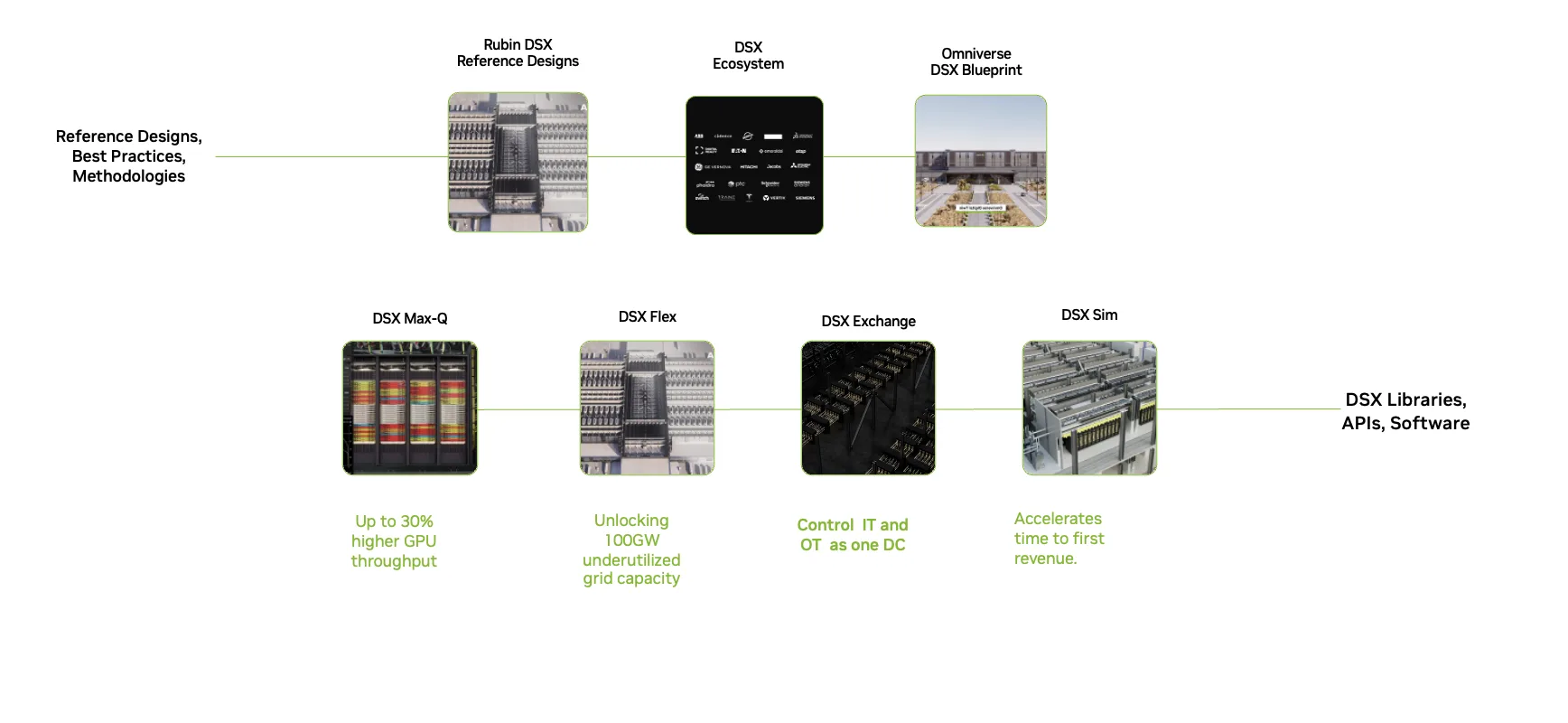
NVIDIA Vera Rubin DSX unifies chips, systems, software libraries, APIs, and a global partner ecosystem into a single architecture that tightly integrates compute, networking, storage, power, cooling, and facility controls across the entire AI factory. This enables ecosystem partners to rapidly design, deploy, and scale gigawatt AI factories with maximum token throughput per watt and improved uptime from resiliency and energy efficiency built into the DSX platform end-to-end.
Learn more about NVIDIA Vera Rubin POD
AI infrastructure is rapidly evolving from discrete chips, standalone servers, and rack-scale systems to co-designed POD-scale supercomputers and AI factories. Modern agentic AI workloads are driving a shift toward purpose-built AI infrastructure that integrates compute, networking, and storage into a single cohesive supercomputer. The NVIDIA Vera Rubin POD unifies five rack-scale systems with key mechanical, power, and cooling innovations from the third-generation NVIDIA MGX rack, delivering scalability, resiliency, and energy efficiency.
At AI factory scale, the NVIDIA Vera Rubin DSX Reference Design and the NVIDIA Omniverse DSX Blueprint for AI factory digital twins provide a unified framework for building and operating AI factories. Together, these innovations deliver dramatic gains in performance, cost efficiency, and energy savings to power the era of agentic applications.
第二部分:解析(深度解读)
一、核心论点速览
NVIDIA 这篇官方技术博客把 Vera Rubin 平台从「单芯片」叙事切换到「机柜级 / POD 级系统」叙事:
- 七类芯片协同:Rubin GPU、Vera CPU、ConnectX-9 SuperNIC、BlueField-4 DPU、NVLink 交换机、Spectrum-6 交换机、Groq 3 LPU,覆盖算力 / 网络 / 存储三域。
- 五套机柜级系统:NVL72(训练+推理核心)、Groq 3 LPX(超低延迟推理)、Vera CPU rack(RL/智能体沙箱)、BlueField-4 STX(KV cache 原生存储)、Spectrum-6 SPX(CPO 网络)。
- 第三代 MGX 机柜:cable-free 托盘、动态供电调度、机柜级电容储能、45°C 液冷、OCP 开放标准、80+ 伙伴供应链。
- 一个 POD 量级:40 机柜、1.2×10¹⁵ 晶体管、近 2 万颗 NVIDIA die、1,152 颗 Rubin GPU、60 exaflops、10 PB/s scale-up 带宽。
🔎 去营销提示:上述「10x 推理每瓦」「35x 更多 token」「5x 更高 tokens/s」等均为 NVIDIA 自述、对照 Blackwell/GB300 的厂商口径,需等待 SemiAnalysis / 第三方 InferenceMax 等独立基准验证,不宜直接当作既定事实。
二、关键概念拆解
| 概念 | 原文定义 | 本站语境解读 |
|---|---|---|
| POD-scale supercomputer | 五套机柜作为「一台」 coherent 超算协同 | 算力竞争从「卖 GPU」升级为「卖整柜 / 整栋 AI 工厂」;系统级集成能力成为护城河 |
| MGX(第三代) | 统一供电/散热/机械 envelope 的开放机柜架构 | 参考 先进封装完全技术概览,机柜是「最大的封装」 |
| NVLink copper spine | 背板 4 个预集成铜缆盒、5000 条铜缆、2 英里 | scale-up 域内仍走铜;SerDes Part 2 的「铜光之战」在此体现为域内铜、域间光 |
| Spectrum-6 SPX + CPO | 102.4 Tb/s 交换机、512 lane、200 Gb/s 共封装光学 | 直接印证本系列 CPO 成为必然 与 光互联瓶颈 主线 |
| Dynamic Power Steering / Max-Q | 在 CPU/GPU/NVLink 托盘间动态调配电力;降档 Max-Q 释放闲置电力 | 指向功率半导体与 MLCC / 硅电容电源完整性 机会 |
| Rack-level energy storage(400 J/GPU) | 电容缓冲功率瞬变,6x 于前代 | 电容 / 储能器件用量随机柜功率密度上升 |
| 45°C 液冷 + UQD08 | 温水进水、快接头、最高 5000A 液冷 busbar | 液冷 CDU / 快接件 / 冷却液供应链机会 |
| CMX(KV cache 存储) | 把推理上下文当 AI-native 共享数据类型卸载到存储层 | 长上下文时代,HBM 之外多了「KV cache 层」的新存储层级 |
三、七芯 + 五柜分层图
1
2
3
4
5
6
7
8
9
10
11
12
13
14
Vera Rubin POD(40 机柜 / 1.2P 晶体管 / 60 EFLOPS / 10 PB/s)
├─ 算力域
│   ├─ NVL72        72×Rubin GPU + 36×Vera CPU,NVLink 铜 spine,3.6TB/s/GPU
│   └─ Groq 3 LPX   256×LPU/柜,直连芯片 spine,超低延迟推理
├─ 控制域
│   └─ Vera CPU rack  256×Vera CPU/柜,22,500+ 并发 RL/智能体沙箱
├─ 存储域
│   └─ BlueField-4 STX  BlueField-4(=Vera CPU+ConnectX-9) + CMX KV cache 存储
├─ 网络域
│   └─ Spectrum-6 SPX  102.4Tb/s,200Gb/s CPO,Spectrum-X / Quantum-X800
└─ 机柜底座(第三代 MGX)
    ├─ 铜 spine(NVL)/ Spectrum-X 或直连芯片 spine(ETL)
    ├─ cable-free 托盘、动态供电、电容储能、45°C 液冷
    └─ OCP 开放标准 + 80+ 伙伴供应链
四、技术趋势与投资含义
1. CPO 从「概念」走向「旗舰量产」——本系列主线被强印证 Spectrum-6 SPX 明确集成 200 Gb/s 共封装光学,是 NVIDIA 在量产交换机中首次把 CPO 写进规格。这与 光子投资地图 的判断一致:CPO 不再是「会不会来」而是「已在机柜里」。但需注意 Third Bridge 光互联瓶颈 指出的节奏——CPO 真正放量在 2027–2028,且 NVIDIA 用自研交换机 + 自研光引擎,对外部可插拔光模块厂是「此消彼长」而非纯增量。另见 CPO 测试缺乏标准化将无法规模化:光引擎上了机柜,测试与良率才是下一个瓶颈。
2. 「七芯协同」= 系统级公司的入场券 能在 rack 级把 NVLink 铜背板 + CPO 光交换 + 动态供电 + 液冷统一调度的玩家极少。这恰好佐证 SerDes Part 2 的论点——SerDes / 互联是系统级公司的护城河,不是单点芯片公司能补的。可对照 AI 硬件入门 与 推理芯片架构地图 理解「大算力块 + 通用小核 + 网络」范式。
3. 供电与散热成为新瓶颈、也是新机会 Dynamic Power Steering、机柜级电容储能(400 J/GPU,6x)、Max-Q、45°C 液冷——每一项都指向功率半导体、MLCC / 硅电容、液冷 CDU / 快接件 / 冷却液。详见 MLCC 与硅电容电源完整性。
4. 先进封装继续加码 单柜 130 万零件、约 4000 磅、cable-free 托盘、17,000 零件/超芯片——机柜是「最大的异构集成」。利好 OSAT / 基板 / ABF / CoWoS 类产能,对照 Intel EMIB vs CoWoS 与 先进封装 masterclass、AMD/Qualcomm 新封装。
5. 开放标准 + 80+ 伙伴 = 供应链分散化 NVIDIA 把机柜设计捐给 OCP、把「设计」开源,但把「生态调度权」抓在手里。对上游是机会(更多合格供应商),但也意味着 NVIDIA 对关键器件有强议价权。
五、与本站其他文章的连接
- 光互联主线:CPO 成为必然|世上没有纯 CPO 股|CPO 测试标准化|光互联瓶颈|硅光子链路预算
- 互联:SerDes Part 1|SerDes Part 2
- 算力/封装:AI 硬件入门|AI 内存入门|推理芯片架构地图|先进封装 masterclass|EMIB vs CoWoS|100 秒瓶颈
- 供电:MLCC 与硅电容电源完整性
六、风险提示
- 厂商口径:全文为 NVIDIA 官方营销表述,性能/能效倍数为自述,需独立基准验证;不可直接当作投资确定性。
- 时间线风险:Vera Rubin NVL72 量产定在 2026 下半年,Ultra(NVL576)/ Kyber(NVL1152)更晚,存在延期与规格调整风险。
- CPO 良率 / 标准化:光引擎进入机柜后,测试与标准化 才是规模化的真实约束,短期产能与良率可能不及宣传节奏。
- 集中度:生态高度围绕 NVIDIA,上游供应商议价权与订单节奏受其调度影响,需分散配置、关注非 NVIDIA 路线(如博通、AMD/Intel 封装)的替代进展。