Sivers Semiconductors:一只被市场忽视的 $130M 市值 CPO / LiDAR / SATCOM 标的
对 Silicon Matter(原 Semis and Stocks)关于瑞典 Sivers Semiconductors 的深度公司剖析的英文原文与中文解读,覆盖 CPO 光器件、LiDAR、SATCOM 三大业务线与估值逻辑。作者持股,非投资建议。
原文:Silicon Matter(Substack,曾用名 Semis and Stocks,handle: siliconmatter),发布于 2026-03-13。 本文为「英文原文 + 中文深度解读」对照版。原作者持有 Sivers Semiconductors 股票,文中内容为个人观点,不构成投资建议。 译注:本译文发布于 2026-08-06;原文数据截至 2026-03-13,部分融资、订单与股价信息可能已有变化,请以最新公开披露为准。
第一部分:正文(Original Article)
Sivers Semiconductors: a $130m mcap co-packaged optics, LiDAR and SATCOM play
With high-quality customer engagements within the CPO, LiDAR and SATCOM markets, Sweden-based Sivers Semiconductors remains overlooked by investors. The company is now approaching an inflection point.
Intro
I’ve been sitting on this piece about Sivers Semiconductors for a while, but ahead of this years’ OFC conference I believe it’s prudent to push the publish button. For those unfamiliar with Sivers, it’s a relatively asset-light and Sweden-based technology company led by CEO Vickram Vathulya, with annual revenues of $33 million and approximately 130 employees. Its current market cap amounts to $130 million (cSEK 1,200 million) and its enterprise value is roughly $140 million.
Much can be written about Sivers and its history, but this piece will keep it high-level and focus on significant business partnerships and projects with near-term re-valuation trigger potential.
The company is highly engaged in the flaming hot CPO (co-packaged optics), SATCOM and LiDAR markets - but is priced as if it was engaged in legacy photonics and RF businesses. Which is a bit confusing considering how the overall photonics segment has sky-rocketed during the past 12 months, fueled by Nvidia’s engagement with Lumentum (+900%) and Coherent (+300%).
Snapshot
Over the past decade, Sivers has pivoted its core strengths into two business areas: Photonics (optical light sources/lasers) and Wireless (radio frequency/mmWave semiconductors).
In 2017, Sivers acquired Glasgow-based CST Global (now the Sivers Photonics business segment), a specialist in III-V photonic lasers with its own R&D facility and clean room (i.e. manufacturing capacity). Back then, the primary goal of the acquisition was to establish a foothold in the consumer electronics market, as VCSELs (vertical cavity surface emitting lasers) were getting implemented in for example smartphones (more specifically, for iPhone FaceID). In recent years, focus has shifted to the data center and LiDAR markets, in both of which Sivers has achieved strong traction with their high-power DFB lasers and laser arrays.
In 2022, Sivers expanded its wireless capabilities by acquiring MixComm, a U.S.-based millimeter-wave (mmWave) startup with a couple of significant customers and projects. With this acquisition, Sivers’ Wireless segment could finally begin its journey from being mainly NRE (non-recurring engineering) focused to instead focus on future product sales. Today, their radio frequency chips are regarded as industry-leading in output power, efficiency, and noise figure - key metrics that directly impact a communication system’s range, reliability and overall economic performance.
Both of these moves, coupled with decades of in-house R&D, have transformed Sivers into a cutting-edge semiconductor designer and supplier with a unique combination of wireless RF and optical photonics expertise. A micro MACOM is perhaps the most fitting analogy. The road has been long and bumpy, but several indicators now suggest that the company is approaching a pivotal inflection point with several relatively large projects moving towards volume ramp.
Fact is that Sivers’ technology has gained validation from several high-profile partners and customers. The company has ongoing customer engagements with Tier-1 telecommunication OEMs, SATCOM operators, Fortune 100 companies, and unicorn tech firms such as ALL.SPACE, Aeva, Ayar Labs, likely Celestial AI via POET Technologies, on mmWave RF solutions, advanced biometric sensors, LiDAR and next-generation optical data center solutions (CPO). Unconfirmed speculations also link Sivers’ laser design expertise to Apple’s well-known ambitions within optical sensing for health applications, in a project that has lasted since 2018.
Photonics segment: CPO and LiDAR
Sivers Photonics is one of the world’s most advanced designer (and small scale manufacturer) of customised III-V lasers, enabling next generation applications in optical data transfer and sensing markets. Yes, you read it right. Sivers Photonics designs, and in a small scale, manufactures customized and very advanced lasers (or more specifically, laser arrays) used in fiber-optic communication, data center interconnects, and various optical sensing applications such as advanced LiDAR sensors.
A laser array typically refers to a laser diode array, which is a device consisting of multiple laser diodes arranged in a linear or 2D configuration on a single chip or mounted together.
The company specializes in indium phosphide (InP) lasers known for their high power capabilities (Fun supply chain fact: IQE supplies Sivers with InP wafers and IQE is using Aixtron’s MOCVD equipment). One of Sivers’ core offerings is high-performance continuous-wave (CW) DFB lasers (distributed feedback lasers), which are key light sources for high-speed optical links. These lasers are engineered for demanding next-generation applications in AI data centers.
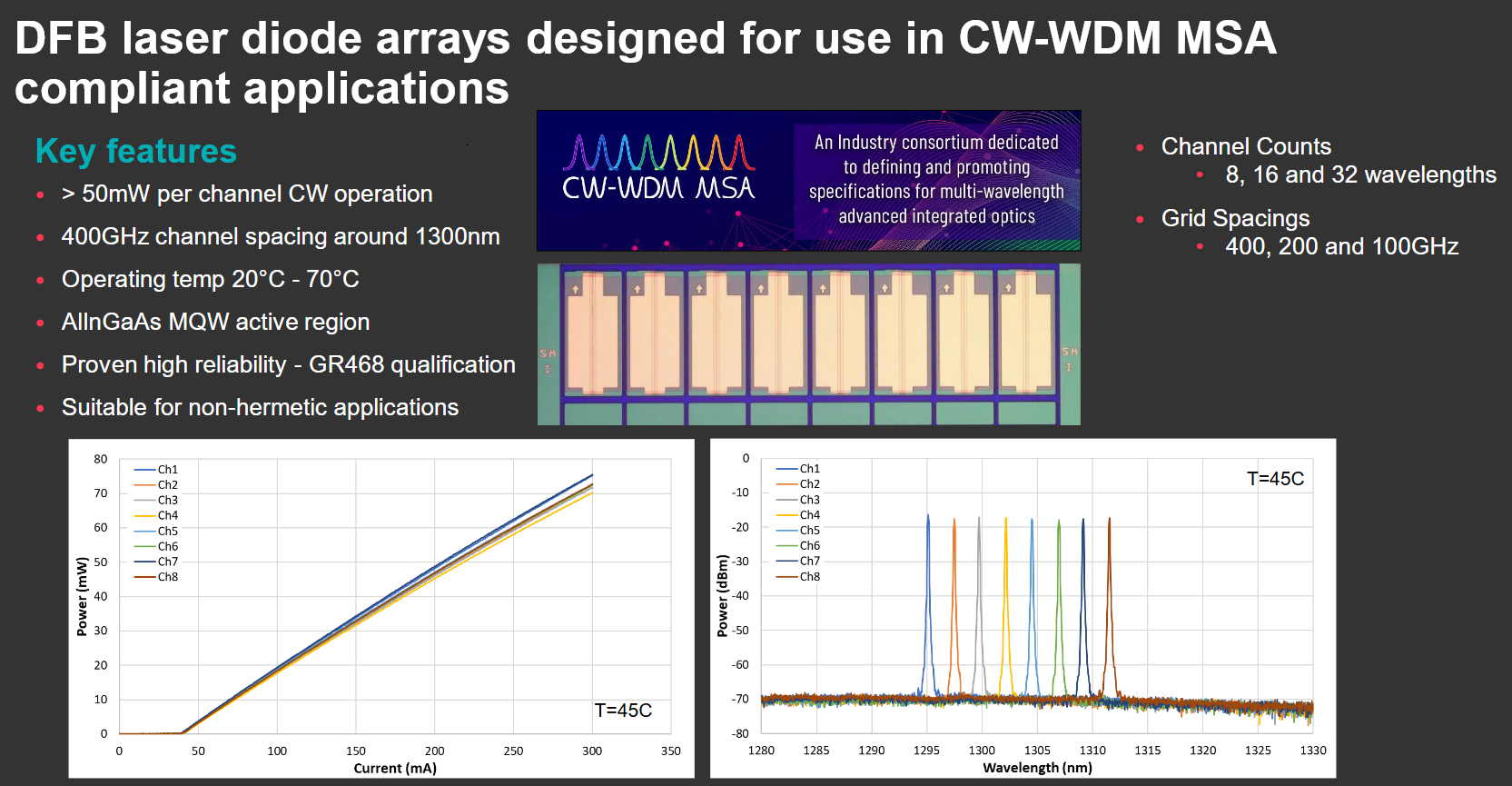 Figure 1. Source: Sivers Semiconductors
A few years back, Sivers’ former CEO Anders Storm said that the company had in-house manufacturing capacity to support an annual revenue run rate of $50-150 million, depending on laser array ASP (average selling price). It is unknown what their actual in-house manufacturing capacity is today, but the company’s current CEO, Vickram Vathulya, has recently stated that it’s currently qualifying its lasers both in-house and also with WIN Semiconductor. And the initial ASP for advanced data center and LiDAR laser arrays will most likely be quite high, probably in the range of $50-75.
AI data center CPO opportunity
As demand for AI workloads surge, modern data centers consist of thousands of accelerator chips (GPUs, TPUs, etc.) that must transfer massive amounts of data between them almost instantaneously. Traditional copper interconnects are becoming a bottleneck at such scale (read more about the bottleneck here: The memory wall and its implications). Sivers Photonics, among others, addresses this issue by providing high-power laser arrays that enable optical interconnects through CPO, essentially using light to transfer data between various chips, servers, or racks at extremely high speeds and low latency.
The chatter about CPO has recently sky-rocketed, which can be seen by the amount of mentions in publicly listed company’s presentation slides and quarterly reports.
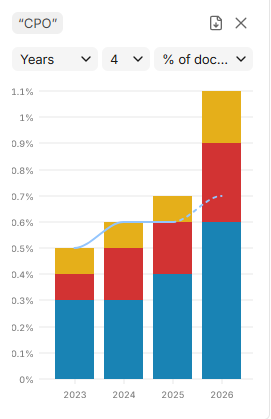 Figure 2. Source: Quartr
Current market estimates indicate that in 2028, approximately 15-20 million AI/data center GPUs will be sold world-wide. Assuming a CPO penetration of 15% among these GPUs imply that 2.2-3.0 million of them will be connected to an external laser array in one way or another. Assuming that each GPU will require 5-10 external laser arrays, at an average ASP of $62.5 per laser array, brings the servicable addressable market for Sivers to $1.0-1.4 billion by 2028. More or less in line with figures provided by Coherent.
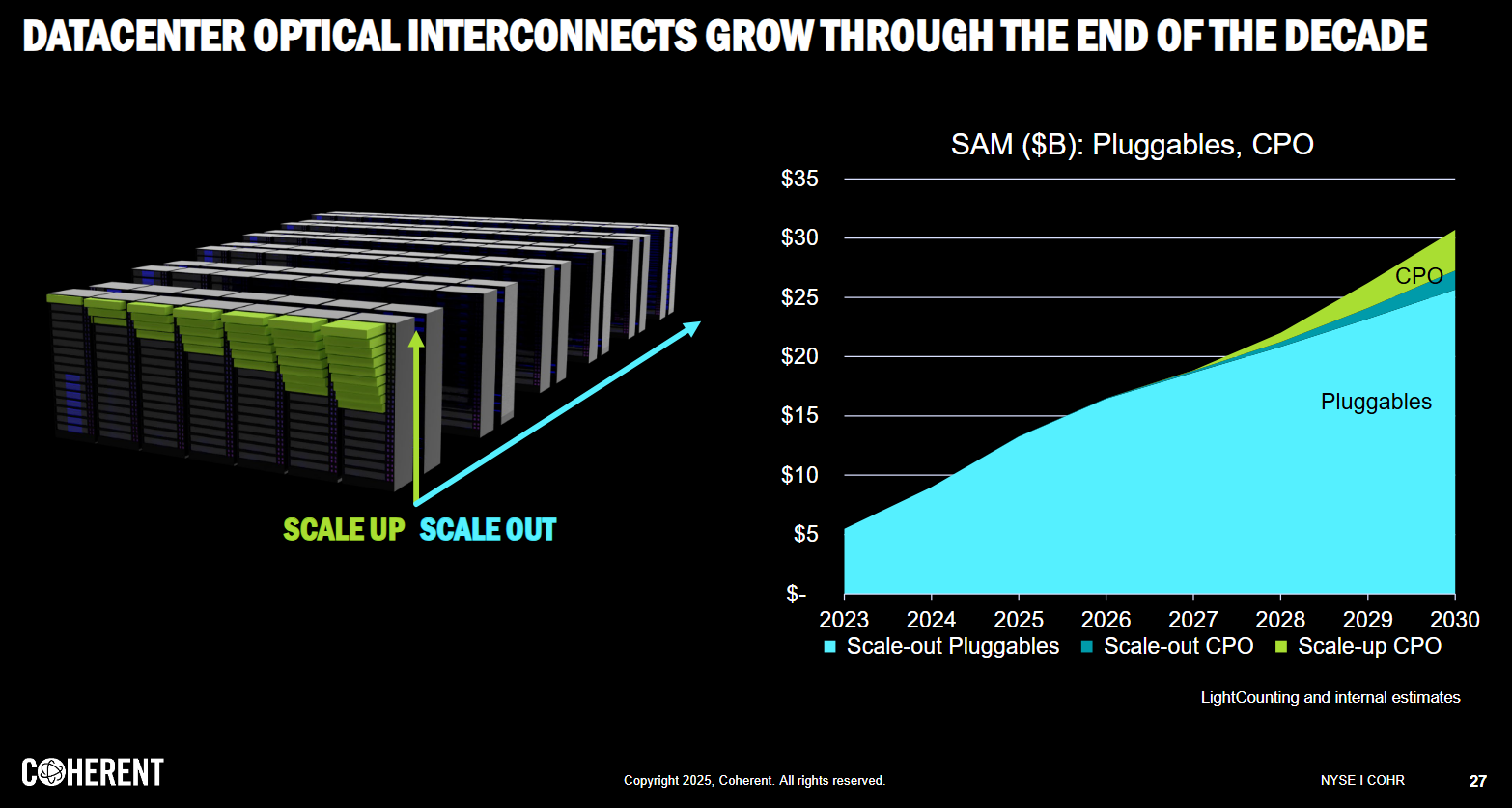 Figure 3. Source: Coherent 2025 Investor Day Presentation
Ayar Labs partnership
As noted, Sivers lasers are suitable for emerging architectures like co-packaged optics. The company has demonstrated this capability through partnerships such as the one with Ayar Labs. Together, they have shown multi-wavelength optical light sources (i.e. laser arrays) integrated in Ayar Labs’ SuperNova™ light source module that feeds the TeraPHY™ optical engine (Ayar Labs’ optical I/O chiplet), achieving extreme bandwidth for data center and high-performance computing (HPC) systems. The TeraPHY optical engine is the industry’s first UCIe optical interconnect chiplet that can deliver 8 Tbps of bandwidth.
The partnership between Sivers Semiconductors and Ayar Labs has been so successful that Lumentum in 2024 poached Ayar Labs’ former VP of Laser and Platform Engineering, appointing him as CTO to strengthen their own foothold in the emerging CPO market. Unfortunately, this move appears to have proven effective. Or has it? Nvidia recently invested $2 billion in Lumentum to “accelerate innovation in advanced optics technologies, including research and development, to enable next-generation AI infrastructure and systems designs.”. But Nvidia also participated in Ayar Labs’ recent funding round.
Ayar Labs recently raised $500 million in a Series E round at a valuation of almost $4 billion. In total, Ayar Labs has now raised $870 million to bring its technology to market, with notable backers such as Nvidia, AMD, Intel and MediaTek. Interestingly enough, MediaTek took a $90 million position in the Series E round.
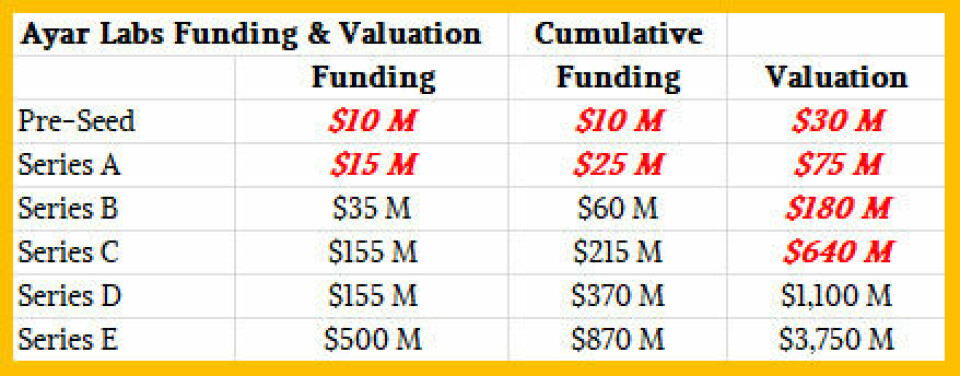 Figure 4. Source: Nextplatform.com
Ayar Lab’s CEO said the following in connection with the recent raise:
“Our customers are aiming at volume ramps that are happening in the 2028 timeframe. We have to get our end to end products selected, validated, and qualified by the second half of 2027, and in the semiconductor world, that’s not that far away. And with this funding, we are really gearing up and driving towards having everything ready to support those ramps in 2028.”
The quote by Ayar Lab’s CEO aligns well with what Sivers Semiconductors’ CEO said in connection with the company’s Q4’25 report:
“We continue work on qualifying our lasers to achieve production ready status in 2027.”
Former Intel CEO, and member of Ayar Labs BoD, Pat Gelsinger stated:
“I proudly declared that the death of copper was upon us, and everything would switch to optics, but I was just two decades too early. The GPU is sitting there sucking on a straw for more compute. Everyone wants their clusters to be bigger, but the physics of copper is limiting how big they can get.”
“The tech has dragged because of thermal headaches and the finicky packaging needed to put optical links alongside silicon without it all going sideways.”
“What makes Ayar Labs so special is they’ve solved all these problems and are ready to go into high-volume production.”
Ayar Labs and Alchip Technologies
The strategic partnership between Ayar Labs and Alchip Technologies (Alchip is essentially a mini Broadcom or Marvell Technologies) is particularly promising. A closer look reveals that Alchip likely has sidelined Marvell in handling the back-end physical and package design for AWS’s Trainium3 and Trainium4 chips. While it’s not yet clear whether CPO technology will play a role in Trainium4, Alchip is a potent strategic partner for Ayar Labs. Even if CPO doesn’t materialize for Trainium4, it could emerge in Trainium5, assuming Alchip retains its design partnership with AWS. Additionally, Alchip could of course also be involved in other hyperscalers’ custom chip design processes. The future will tell.
In a recent webinar, Alchip stated that they believe hyperscalers will be the first ones to adopt scale-up CPO through custom chip/ASIC designs. That is one interesting comment, to say the least.
POET Technologies and O-Net partnerships
Sivers Semiconductors has also formed a strategic collaboration with POET Technologies. Together they are developing high-performance and cost-effective external light source (ELS) modules tailored for CPO and next-generation AI infrastructure.
POET is since long supplier of Celestial AI, a company competing with Ayar Labs, and which recently got acquired by Marvell Technologies for $3.25 billion ($5.5 billion with earn-outs). During Marvell’s conference call following the acquisition, their CEO stated that they currently expect Celestial AI to reach an annual revenue run rate of $500 million by the end of its FY 2028, and $1 billion by the end of its FY 2029.
 Figure 5. Source: Marvell Technologies
While Marvell Technology’s acquisition of Celestial AI may pose a long-term threat to POET Technologies since they have a long and deep collaboration with TSMC and likely wants to leverage TSMC’s COUPE platform (just like Ayar Labs and Alchip does), it is quite unlikely that Marvell replaces POET in its near- to mid-term product launches and deployments. But it remains a thing to watch out for.
Celestial AI currently uses POET’s optical interposer platform to enable disaggregation of memory and compute (having memory chips located at one place of a system, and compute chips at another place) allowing for significantly higher performance. POET is also developing and producing specialized multi-laser integrated external light source modules specifically for Celestial AI to power next-generation AI data centers.
“POET Technologies introduces “POET Starlight” for the Artificial Intelligence market and receives advanced purchase order from Celestial AI.”
At OFC, POET will showcase two leading external light source (ELS) products. It’s not far-fetched to assume that one or several of these new products will host Sivers laser arrays.
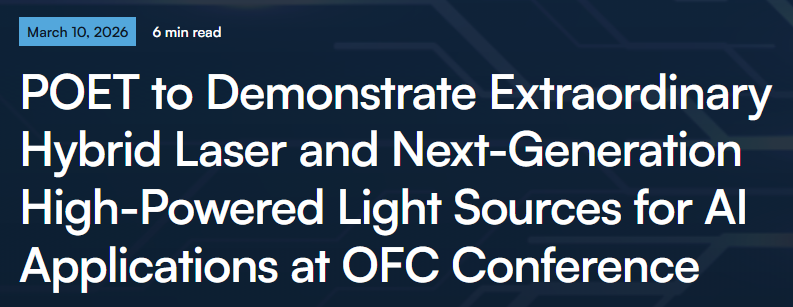 Figure 6. Source: POET Technologies
Another exciting collaboration (referring back to the market figures provided by Coherent) that Sivers Photonics initiated last year was the OEM partnership with O-Net. Though relatively unknown to many, O-Net is a major player in pluggable optics modules and is part of Nvidia’s supply chain for such modules (note that it is unlikely that Sivers will supply Nvidia via O-Net in the near- to medium-term). Under the agreement with Sivers, O-Net will serve as an OEM partner, integrating Sivers’ advanced DFB laser arrays into their external laser small form factor (ELSFP) optical modules. This is a step by Sivers to offer “standardized off the shelf” laser arrays to a wider audience via O-Net’s pluggable optics modules.
LiDAR customer volume ramp in Q4 2026
The same qualities that make Sivers’ laser arrays suitable for data centers (compact size, high power, efficiency etc.) are also valued in optical sensing fields for various optical sensors. Precise and high-power multi-wavelength DFB laser arrays make a good case for advanced and innovative sensor systems like automotive LiDARs.
Just recently, Sivers announced that a strategic LiDAR customer will ramp its remote sensing production in Q4 2026. The company expects to supply lasers and optical amplifiers with cumulative revenue potential ranging from $53-138 million over the customer’s product lifecycle. While the customer remains unconfirmed, much points at Aeva Technologies who recently announced that they have been selected to integrate its platform into the NVIDIA DRIVE Hyperion autonomous vehicle reference platform on production vehicle programs, targeting 2028 start of production.
A revenue range of $53-138 million during a typical 10-year automotive lifecycle (mid-point indicates annual average revenues of $9.5 million) should be put into the perspective that Sivers today generates approximately $33 million in annual revenues, most from NRE projects. A successful volume ramp by this (one) customer would result in a pretty decent product sales contribution.
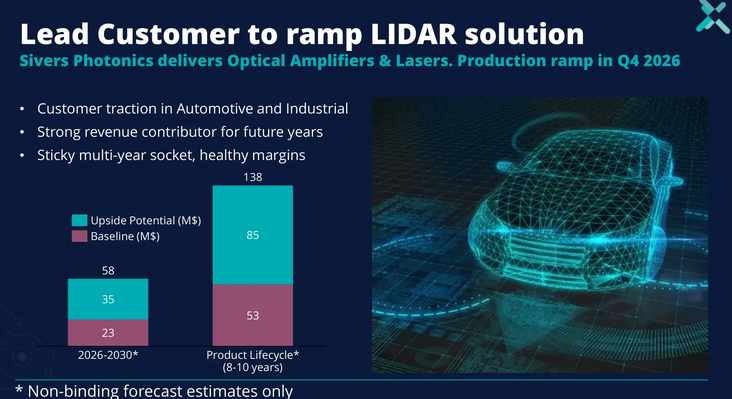 Figure 7. Source: Sivers Q4’25 presentation
Why tiny Sivers Photonics?
It is difficult to pinpoint exactly why all of these companies have decided to work with Sivers, of all potential photonics companies out there. Were they cheaper? Did they offer quicker turnaround times? Or was it simply because of cutting-edge expertise?
Without being 100% certain that this is why, Sivers appears to be employing innovative wafer-scale manufacturing techniques, such as etched-facet lasers with on-wafer optical coatings and testing (i.e. no need to cleave wafers to test these edge-emitting lasers) to achieve high yields and lower costs. This helps customers scale up volume production and lower packaging costs, a well-known bottleneck within silicon photonics. While competitors have likely adopted similar techniques today, Sivers was likely among the earliest InP DFB laser designers and manufacturers with this approach.
Wireless segment: mmWave and SATCOM
Sivers Wireless is a fabless (GlobalFoundries manufactures its RF chips) designer of advanced RF chips, with particular focus on mmWave frequencies and beamforming ICs. For those not familiar with the topic, mmWave technology refers to radio spectrum roughly in the 24-100 GHz range, which offers huge bandwidth and very high data transfer rates. It could be defined as the “real 5G”, as opposed to sub-6 GHz 5G.
Moving to higher frequencies dramatically increases available communication capacity, while also allowing smaller components due to the shorter wavelengths. These attributes make mmWave ideal for emerging applications that demand multi-gigabit wireless connectivity in compact form factors.
Sivers beamforming RFICs can enable ultra-fast wireless backhaul and fixed wireless access links in 5G networks, supplementing fiber in dense urban deployments and/or connecting rural areas with broadband services.
A beamforming RFIC is a specialized semiconductor device that controls the direction and shape of radio frequency signals in an antenna array.
The company has ongoing customer engagements with a Tier-1 telecom OEM (likely Nokia, but it’s unconfirmed) to develop a mmWave beamforming transceiver for 5G infrastructure, underscoring their competitiveness alongside much larger RF semiconductor players such as Qualcomm and Analog Devices. The current status of this project is that the customer likely will release its 1st and 2nd generation of equipment by end of 2026, while development of the 3rd generation is on its way together with Sivers.
SATCOM and ALL.SPACE
Satellite communications (SATCOM) has however emerged as the flagship area for Sivers Wireless in recent years. In particular their partnership with UK-based ALL.SPACE, the only provider of SATCOM terminals that can uphold multiple links simultaneously across various bands over all orbits (LEO, MEO and GEO). A neat feature as the SATCOM industry is witnessing a boom in multi-orbit satellite constellations and increased demand for redundancy.
ALL.SPACE recently achieved TRL 6 with U.S. Army, which is a big step towards actual deployment and volume production. They are also establishing manufacturing capacity in Muscle Shoals, Alabama. One can just wonder why!
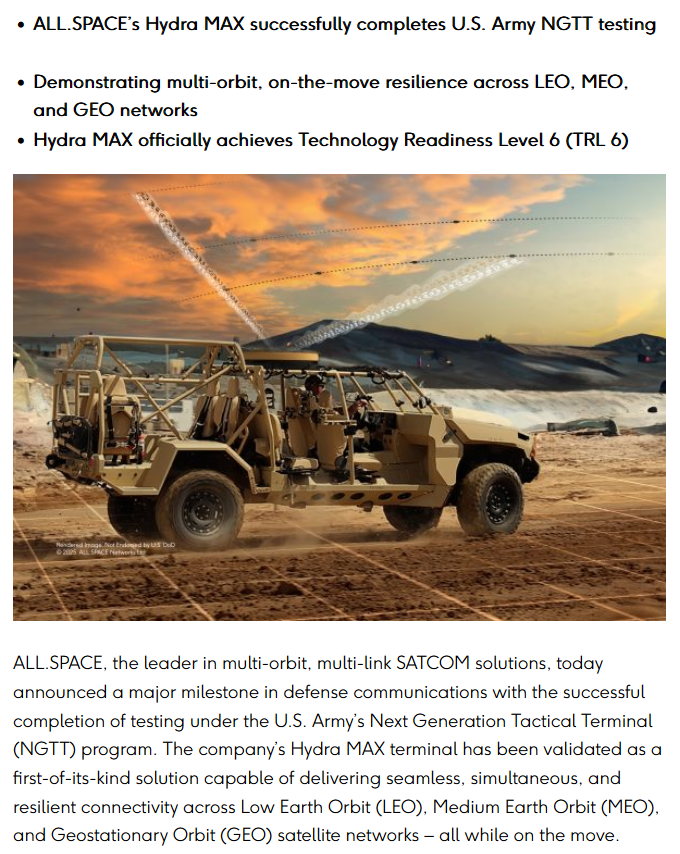 Figure 8. Source: ALL.SPACE
A couple of years ago, Sivers’ former CEO stated that each ALL.SPACE terminal would contain approximately 1,800 chips from Sivers, with the value of Sivers’ content totaling about $9,000 per terminal. These figures may have changed since then, especially as ALL.SPACE has launched additional and more advanced terminals, but it still offers a useful ballpark figure. With ALL.SPACE now establishing a presence in the United States, it’s fairly reasonable to assume that initial annual volumes could reach 500-700 terminals once deployment begins. Which would translate to initial annual revenues of $5-6 million for Sivers.
US CHIPS Act funding
As icing on the cake, in late 2024 Sivers Wireless was awarded an initial $11 million for leading two projects within the US CHIPS Act, with partners such as Northrop Grumman, Raytheon, Ericsson and BAE Systems. The two projects are in the areas of 5G/6G and electromagnetic warfare, and the CHIPS Act funding can be extended beyond the first 12 months. For now, we know that at least one of these projects is likely to be extended in the near future:
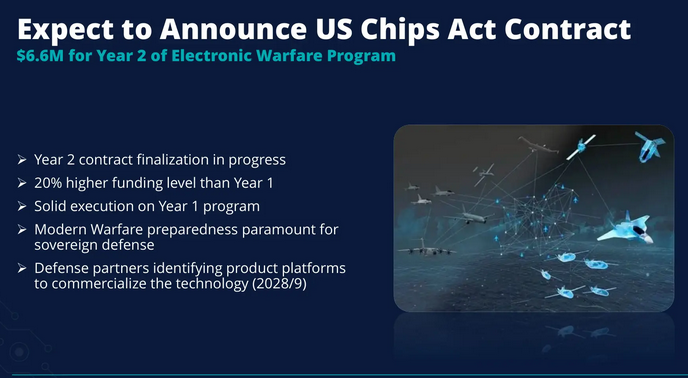 Figure 9. Source: Sivers Q4’25 presentation
Financials, strategy and valuation
Sivers’ financial history is hardly a success story. Frankly, it has been a nightmare plagued by repeated share issues. That being said, establishing credibility in the semiconductor industry takes time and is very costly. Since 2017, the company has made good progress, leveraging well-executed NRE projects and strategic M&A to build its reputation and expand its network.
The company’s focus has now pivoted toward product sales, more selective customer engagements, and greater emphasis on developing and marketing standardized products for a broader audience.
In 2025, Sivers posted record full-year revenues of SEK 304 million (approximately $33 million), up 25% y/y (or 33% in constant FX), fueled by robust growth in both its Wireless and Photonics segments. Its “opportunity pipeline” also surged 64%, from $276 million to $453 million, indicating accelerating customer engagements. Adjusted EBITDA of SEK -11 million (-$1.2 million) improved by 31% y/y, underscoring operational efficiencies, while product revenues rose 13% in constant FX amid a transition to a more scalable business model.
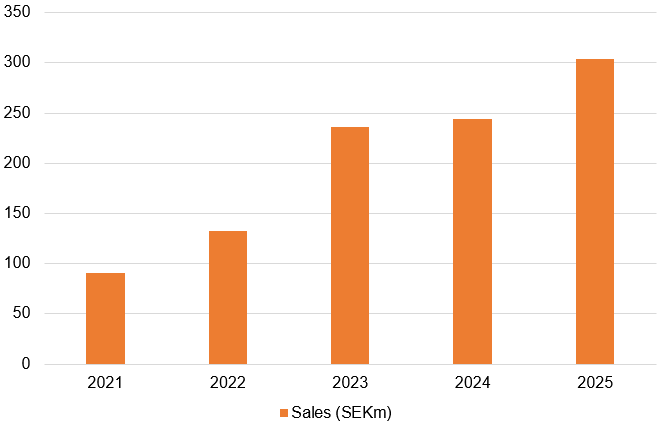 Figure 10. Source: Sivers Semiconductors
This article won’t delve into detailed growth or margin projections. Given the speculative aspects of Sivers Semiconductors outcome in the CPO market, it will leave those exercises to individual readers.
That said, considering the partnerships and initiatives outlined earlier (especially in CPO where 2028 SAM is expected to be in the $1.0-1.4 billion range), it is not difficult to end up with a revenue growth trajectory that pushes Sivers to annual revenues of $100-125 million (SEK 900-1,300 million) over the next 36 months, reaching that level by the end of 2028. On the flip side, if CPO adoption faces delays or if Sivers encounters limited volume allocations, a more conservative outlook might see annual revenues landing at $50-60 million during the same timeframe. The anticipated 10-year LiDAR lifecycle revenue of $53-138 million, along with ongoing projects in the Wireless segment, should provide downside protection in the years ahead.
Typical gross margins for companies like Sivers Semiconductors is in the range of 50-60%. With Sivers’ fairly low fixed cost base, its operational leverage could be quite substantial if the company starts delivering volumes.
Valuation-wise, Sivers current NTM EV/sales multiple of 4x (pre-volume ramp!) does not factor in any future success at all within CPO. In the conservative scenario with CPO delays and/or lack of meaningful volume allocation, Sivers is currently trading at an EV/sales multiple of 2.5x on expected revenues in 2028.
If the market eventually gains greater confidence in the company’s ability to reach annual revenues of $100 million by the end of 2028 (compared to $33 million in 2025), what EV/sales multiple could it assign? 2x, 5x, or 10x? The chart below offers a glimpse into how U.S. investors are currently valuing sector peers. There is plenty of upside potential if the company manages to attract investors’ attention and instills confidence in its ability to win CPO volumes.
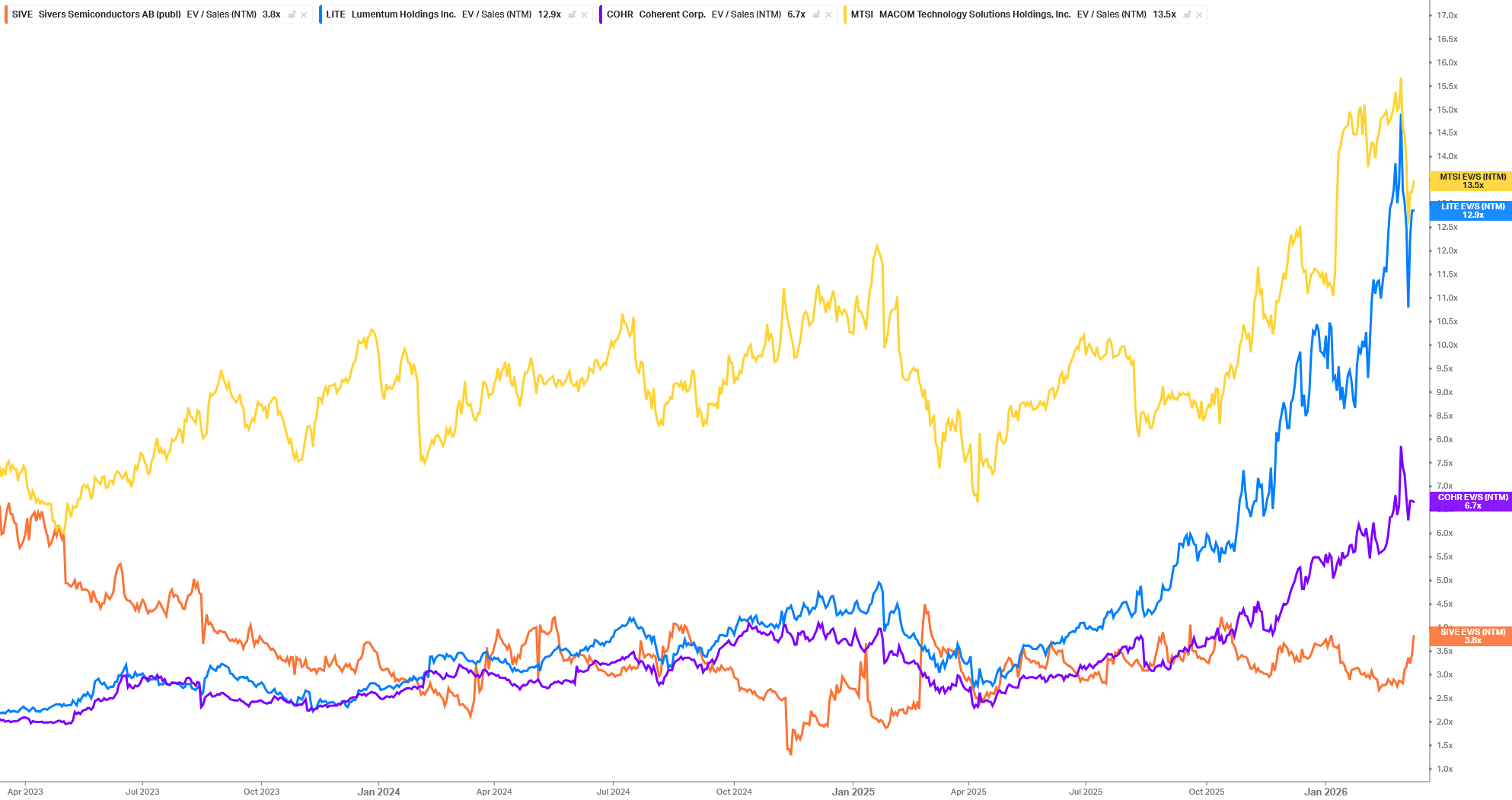 Figure 11. Source: Koyfin
Risks
While Sivers has shown revenue growth and operational progress in recent years, it still remains in a development phase with persistent losses and financing needs. Below is a few notable risks associated with the company.
- Liquidity and financing risks: The company has reported negative cash flows from operations (SEK -57 million in 2025, improved from SEK -72 million in 2024) and relies on external funding, including directed share issues (SEK 95 million in September 2025 and SEK 108 million in January 2025) and loans/convertibles.
- Ownership structure: The company’s shareholder base lacks significant involvement from major global institutional investors. There is also an absence of strategic or industry-specific investors, leaving the company reliant on retail investors.
- Customer concentration and demand volatility: A large share of Sivers revenue comes from a few key customers in the Wireless segment, with risks of reduced orders and/or project delays. Broader market slowdowns in 5G rollout, SATCOM, or AI data centers driven by macroeconomic factors or postponed investments could reduce demand and lead to revenue shortfalls.
- Technological and competitive risks: The semiconductor sector is highly competitive, with larger players potentially outpacing Sivers in innovation or pricing. Risks include failure to meet technological milestones, IP theft, or obsolescence of products.
Final remarks
Readers that have made it this far have most likely come to realize that Sivers Semiconductors currently is operating in a couple of secular mega trends and that the company has managed to attract prominent customers and partnerships through its cutting-edge chip design and/or manufacturing expertise.
The company now stands at a compelling crossroads, hoping to capitalize on the expected explosive growth of photonics in data centers, LiDAR for autonomous vehicles, and next-generation SATCOM terminals. With validated partnerships the company is poised for a potential inflection point as projects transition from development to volume production by 2027-2028.
At its current valuation of mere $130 million, Sivers appears undervalued relative to peers, while offering downside protection through LiDAR revenues ramping from Q4 2026 onwards.
Disclaimer:
The above text is not investment advice. It includes several of the author’s own assumptions that may be incorrect. Do your own research and consult investment professionals before investing in companies like Sivers Semiconductors. The author owns shares in Sivers Semiconductors.
第二部分:解析(深度解读)
核心论点摘要
瑞典半导体公司 Sivers Semiconductors(市值约 $130M、企业价值约 $140M、年收入约 $33M、约 130 名员工)同时卡位了三条高景气赛道——CPO(共封装光学)光器件、车载 LiDAR、卫星通信(SATCOM)——却被市场按「传统光子学 + RF」的旧框架定价。作者 Silicon Matter 认为,在光子学板块过去 12 个月因 Nvidia 拉动 Lumentum(+900%)、Coherent(+300%)而整体起飞的背景下,Sivers 明显被低估,且正临近「从研发/NRE 走向量产」的拐点(2027–2028 放量)。
一句话结论:Sivers 是「迷你版 MACOM」——同时具备无线 RF(mmWave 波束成形 IC)与 InP 光子学(高功率 DFB 激光器阵列)这两项稀缺且互补的能力,且已获得 Ayar Labs、POET、O-Net、ALL.SPACE、Aeva 等头部客户的验证。
关键概念解读
- 外部激光阵列(External Laser Array / ELS):CPO 把光引擎(光学 I/O)与 CPU/GPU 合封,激光器却常被移到封装外(ELS/ELSFP 模块),由 Sivers 这类 InP DFB 激光器厂商供货。这是 Sivers 在 CPO 叙事里的核心卡位点——光不再从铜里挤,而是用外部激光阵列喂给合封光引擎。
- InP DFB 激光器(磷化铟分布反馈激光器):连续波(CW)高功率,是 AI 数据中心高速光链路的关键光源。Sivers 的护城河之一是 wafer-scale 制造工艺(etched-facet + on-wafer 光学镀膜与测试,无需解理晶圆即可测边发射激光器),以此提良率、降封装成本——这正是硅光子学量产的经典瓶颈。
- 激光阵列(Laser Array):多颗激光二极管在一颗芯片上线性/二维排布,多波长 WDM 光源,喂给 Ayar Labs 的 SuperNova™ 光源模块、TeraPHY™ 光 I/O chiplet(8 Tbps)。
- mmWave 波束成形 RFIC(射频集成电路):控制天线阵列中射频信号的方向与形状,支撑 24–100 GHz「真 5G」回传与 FWA。Sivers Wireless 由 GlobalFoundries 代工,与 Qualcomm、ADI 同台竞争,绑定某 Tier-1 电信 OEM(疑似 Nokia)。
- SATCOM 终端芯片含量:每个 ALL.SPACE 终端含约 1,800 颗 Sivers 芯片、单终端含量约 $9,000;初期年出货 500–700 台即对应 Sivers 年收入 $5–6M。
业务拆解表:Sivers 三线布局
| 业务线 | 主体 / 收购源 | 核心产品 | 关键客户 / 拐点 |
|---|---|---|---|
| Photonics(光子学) | CST Global(2017 收购,格拉斯哥) | 高功率 InP DFB 激光器阵列、CW 光源 | Ayar Labs、POET、O-Net、疑似 Celestial AI / Apple;CPO 2027 量产就绪、2028 SAM $1.0–1.4B |
| Wireless(无线) | MixComm(2022 收购,美国 mmWave) | mmWave 波束成形 RFIC、SATCOM digitizer | 某 Tier-1 电信 OEM(5G,2026 出 1/2 代)、ALL.SPACE(SATCOM)、US CHIPS Act($11M 起步) |
| LiDAR(车载传感) | Photonics 复用 | 多波长 DFB 激光阵列 | 某战略 LiDAR 客户(疑似 Aeva)Q4 2026 量产,生命周期收入 $53–138M |
产业趋势与催化链
- CPO 时间线高度一致:Ayar Labs CEO「2028 放量、2027 下半年完成认证」↔ Sivers CEO「2027 达到量产就绪」↔ Pat Gelsinger「铜已到物理极限、Ayar 已解决量产」。Sivers 的激光器是这条链的上游稀缺件。
- Ayar Labs 是 CPO 风向标:Series E $500M、估值近 $4B,累计融资 $870M,背后 Nvidia / AMD / Intel / MediaTek。Sivers 是其多波长光源合作方——Ayar 放量即 Sivers 放量。
- POET / Celestial AI / O-Net 是第二、第三增长曲线:Marvell 以 $3.25B 收购 Celestial AI(POET 长期供货),O-Net 作为 Nvidia 可插拔光模块供应链的 OEM 伙伴把 Sivers 激光器做成「标准化货架件」。
- LiDAR 提供下行保护:Q4 2026 单一客户放量,10 年生命周期 $53–138M,相对当前 $33M 年收入是实质增量。
- 财务拐点:2025 全年收入 SEK 304M(+25% y/y),机会管道 $453M(+64%),Adj. EBITDA 改善 31%;毛利率 50–60%,固定成本低 → 一旦放量经营杠杆显著。
估值框架(原文逻辑)
- 当前 NTM EV/Sales ≈ 4x(放量前),已隐含「CPO 完全失败」的保守预期(对应 2028 收入仅 2.5x)。
- 若 2028 年收入做到 $100–125M(中枢)、市场给予 5–10x EV/Sales,相对当前 $130M 市值有显著上行空间;保守情景(CPO 延迟)收入 $50–60M,仍由 LiDAR + Wireless 提供保护。
- 注意:这是作者(持股者)的个人假设,非投资建议。
与本站其他文章的连接
- 本篇是 CPO 系列的「器件层」补完:本站的 CPO Fully Dissected、There Is No Such Thing As A CPO Stock、CPO Biggest Bottleneck: High Volume Testing 讲系统架构与生态,本篇讲 CPO 上游激光器供应商这一具体标的。
- 电侧互连底座见 Pushing the Speed Limit:224/448Gbps 时代的 SerDes 收发器架构拆解——SerDes 撞上铜的物理极限,正是 CPO「用光替代铜」的需求源头;Sivers 的 ELS 正是这条故事的供给侧答案。
风险提示
- 本文为投资视角的公司剖析翻译与解读,不构成投资建议;原作者持有 Sivers 股票,观点含个人假设。
- 融资 / 流动性风险:经营现金流持续为负(2025 年 SEK -57M),依赖定向增发与可转债;稀释风险高。
- 股权结构脆弱:缺乏全球机构与战略投资人,以散户为主。
- 客户集中 + 需求波动:Wireless 段收入依赖少数大客户;5G / SATCOM / AI 数据中心任何放缓都会拖累。
- 技术与竞争风险:大厂(Lumentum、Coherent、Marvell 等)可能更快或更便宜地自研/整合,存在 IP 与迭代风险。
- 英文原文图表版权归 Sivers / Coherent / Marvell / POET / ALL.SPACE / Koyfin / Quartr / Nextplatform 等各自所有,引用已标注来源。