Lasers for CPO/NPO: Part 1 – The InP DFB Laser — CPO/NPO 激光器(一):InP DFB 激光器原理
整理自 Viks Newsletter:CPO 超高功率(UHP) CW 激光器是供应链隐形 choke point,Lumentum 公认领先但工程难点少有人讲清。系列第 1 篇(基础篇)从第一性原理拆 InP DFB 激光器——多量子阱增益、自发/受激辐射、L-I 曲线与温度阈值,并指出 Lumentum 的优势可追溯到 2007 年 JDS Uniphase 的 DFB 设计(片上 600mW、出纤 350mW、线宽 <500kHz)。英文原文(免费公开部分,至 L-I 曲线)+ 中文深度解读。
本文整理自 Viks Newsletter(Substack)的付费技术专栏,原文发布于 2026-07-15(作者署名为 Viks / SemiExponent)。 标题原文:Lasers for CPO/NPO: Part 1 – The InP DFB Laser。本文为系列第 1 篇(基础篇)。 结构为 正文(英文原文)+ 解析(中文深度解读),方便中英对照阅读。 ⚠️ 本文来源标注为付费可单篇购买文章。jina 抓取的公开免费部分涵盖引言、2007 Lumentum/JDS Uniphase 案例、MQW 增益段、自发/受激辐射、L-I 曲线与温度阈值(至第一张 L-I 图);后续 DFB 光栅设计、激光线宽(Schawlow-Townes-Henry)、低功率/高功率 DFB、UHP 四道墙(热/线宽展宽/取光/灾难性光损伤) 等核心工程章节位于付费墙之后,本发布未包含任何付费内容。作者明确声明本文纯技术拆解、”非 Lumentum 投资建议”。
第一部分:正文(Original Article)
Lasers for CPO/NPO: Part 1 – The InP DFB Laser
Viks Newsletter · Jul 15, 2026
There is a lot of FUD in the market about ultra high power (UHP) lasers for CPO and who the leading provider is in this segment. Everybody I’ve asked about UHP lasers unequivocally says Lumentum is in the lead, but few are able to discuss the engineering challenges in making UHP lasers, where the Lumentum advantage lies (if it even exists), and what the real alligator-filled moat is that keeps competitors out.
The goal of this article series is not to dethrone Lumentum or advocate for an alternative provider in any way. It is to understand the true difficulty of making UHP lasers for CPO from first principles, so that the reader is well informed enough to cut through the noise and think for themselves.
Instead of examining generic laser architectures, we will directly address the one that Lumentum says their structure is most similar to, in their CLEO 2022 paper.
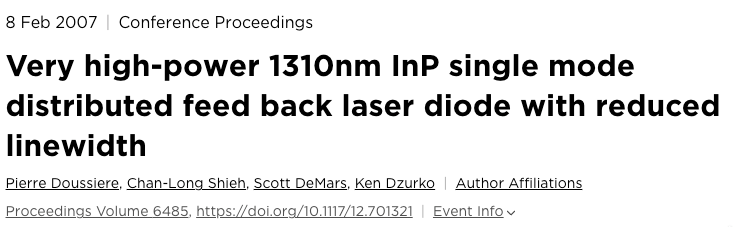
In their CLEO 2022 paper, it seems interesting that Lumentum would quote a paper from 2007 as the basis for their high power laser design. These authors at the time were affiliated with JDS Uniphase, which spun off in 2015 to become the publicly traded, and well loved company that we know as Lumentum today.
Interestingly, none of those authors work at Lumentum any more. Another important takeaway is that Lumentum has been working on UHP lasers since before they were Lumentum. As it turns out, 20 years later, this precise laser architecture is what the world wants for CPO and Lumentum just happens to have a ton of experience with it.
This 2007 paper describes a 1310 nm InGaAsP/InP DFB doing 600 mW on-chip and 350 mW ex-fiber with sub-500 kHz linewidth, and is spec-for-spec the ancestor of the UHP laser Lumentum sells for CPO today. We’ll use this as a case study to understand UHP lasers and how its related challenges were solved, but is still by no means an endorsement for investments in Lumentum. Do your own research.
To understand how to make a good UHP laser requires a background in how these devices work. This first part is groundwork: how an InP DFB laser works and the physical walls that make high power hard. Where Lumentum’s advantage actually lies, and how deep the moat runs, needs this physics first, so that verdict waits for Part 2.
Contents:
- InP laser diode fundamentals
- Multiple Quantum Well structure
- L-I curve, spontaneous vs stimulated emission
- Distributed Feedback (DFB) grating design
- Mode-hopping
- How to space gratings
- How DFB works
- Refractive index changes
- Reflection strength and length
- Laser Linewidth and DFB Cavity Length
- Calculating linewidth: Schawlow-Townes-Henry equation
- Impact of power, mirror loss and dependence on length
- Low Power DFB Lasers for Telecom/EML
- Direct modulated lasers (DML)
- CW lasers and EMLs
- High Power DFB Lasers for CPO
- How to increase output power
- The 4 walls of UHP lasers
- Heat
- Linewidth widening
- Getting light out
- Catastrophic optical damage
The Indium Phosphide (InP) Distributed Feedback (DFB) laser is the fundamental component of optics today, so it is best we understand how it works. It consists of two basic parts built on the same piece of material: The InP laser diode and DFB grating.
This is often called the gain section and its job is to convert electrical current into optical power. The light is generated by Multiple Quantum Wells (MQW) in an “active region” which are essentially alternating layers of InGaAsP (Indium-Galium-Arsenic-Phosporus) sandwiched together. The alternating layers have slightly different compositions of these fundamental elements, so that they have slightly different energy levels. The purpose of this structure is to trap electrons in a low-energy layer between two high energy layers so that the electrons are trapped in a “well” and can’t get out. Multiple wells means more electrons, which means stronger laser output.
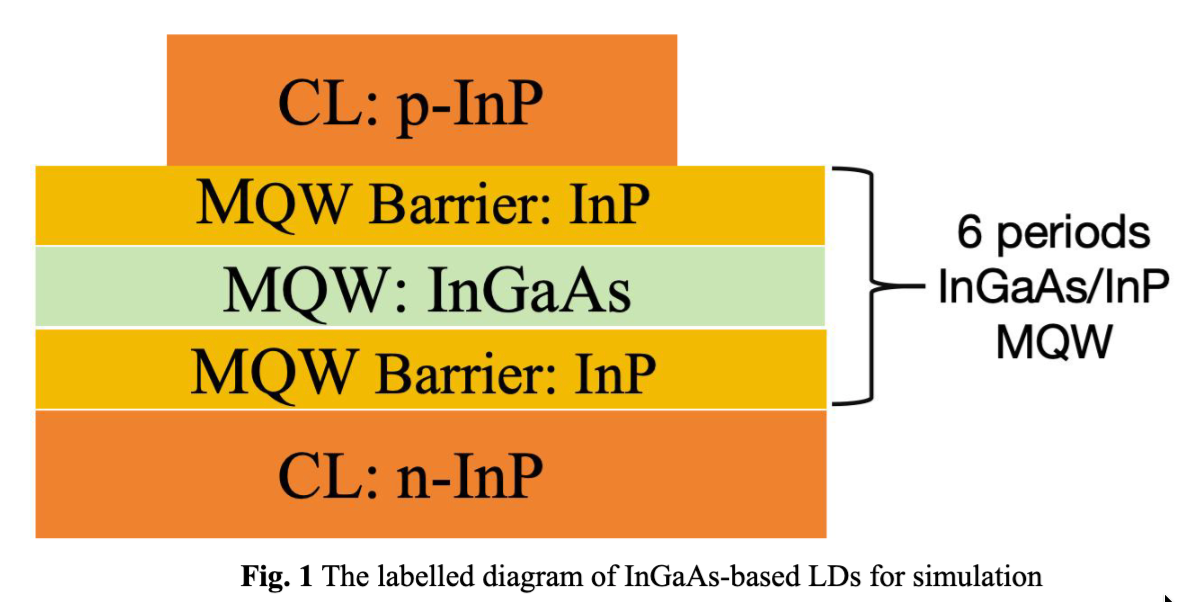
Source: Effects of multiple quantum well width on InGaAs/InP laser diode, doi:10.1088/1742-6596/2937/1/012007.
To generate light, current is applied to the laser diode by applying a voltage across the anode and cathode. When the current applied is low, the emission of light is a messy stream of light waves out of phase with each other, each one behaving independent of the other. This is called spontaneous emission, and is not a focused beam of light; it is much like LED light. If photons were people, they would just wander around in a park without purpose.
Beyond a threshold of current, stimulated emission kicks in. The photons generated in the presence of a highly concentrated “well” of electrons kick up more photons themselves resulting in an avalanche of more photons. These photons now march in step with their phases correlated to each other. Now the photons are on a military parade in complete lockstep while being highly directional and focused.
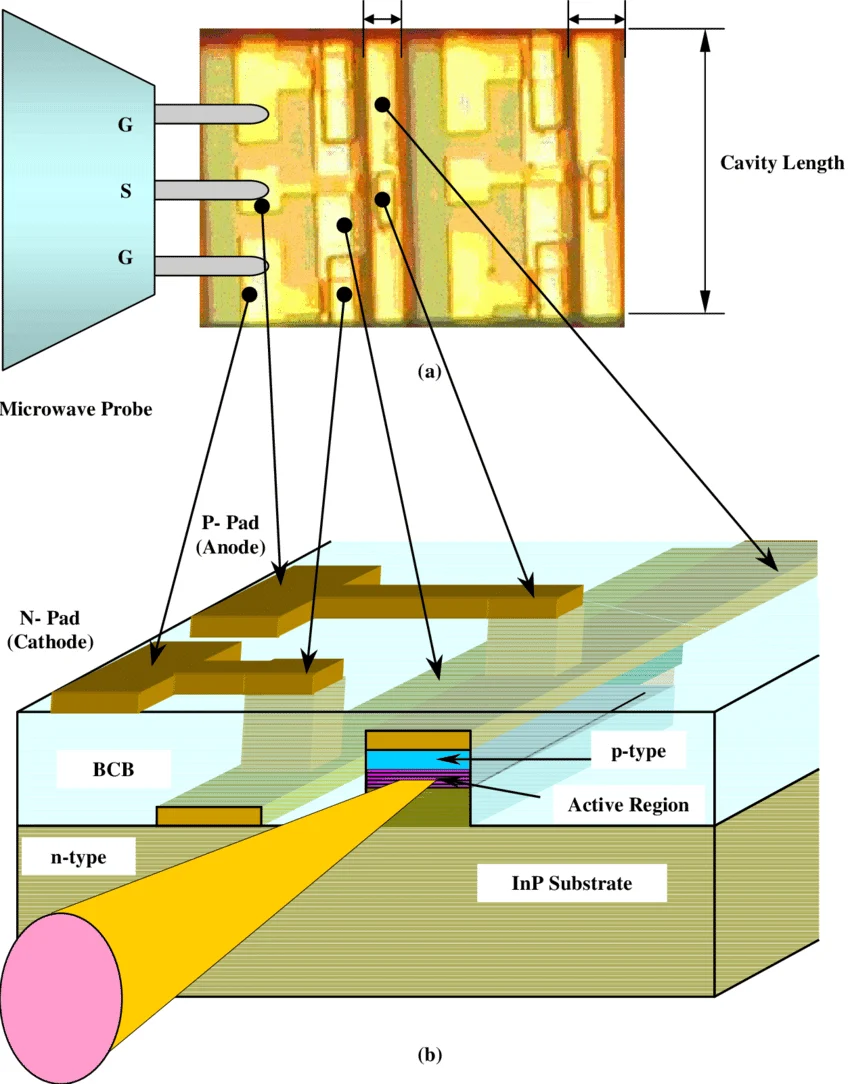
Source: Wide-Band and Scalable Equivalent Circuit Model for Multiple Quantum Well Laser Diodes, Jae Hong Kim, PhD Thesis, Georgia Tech 2005.
This relationship between light and applied current is represented by the L-I diagram shown below. The threshold of current needed to make photons march together depends on the temperature; higher temperatures need more drive current. This is an important observation that will later drive a lot of our understanding of UHP lasers.
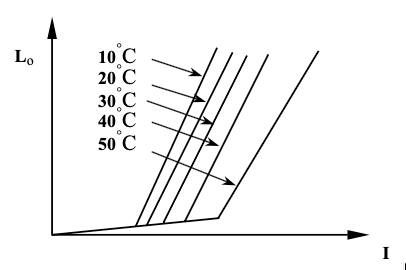
Source: Wide-Band and Scalable Equivalent Circuit Model for Multiple Quantum Well Laser Diodes, Jae Hong Kim, PhD Thesis, Georgia Tech 2005.
第二部分:解析(深度解读)
核心论点摘要
Viks 这篇是 CPO/NPO 激光器系列的第 1 篇(基础篇),目标是拆掉市场上关于”CPO 超高功率(UHP) CW 激光器”的 FUD(恐惧/不确定/怀疑)。共识是 Lumentum 领先,但很少有人能讲清:工程难点到底在哪、Lumentum 的优势是否真实存在、真正把对手挡在门外的”鳄鱼潭”护城河有多深。
作者的切入点很聪明:直接拿 Lumentum 自己在 CLEO 2022 论文里说”结构最相似”的那篇 2007 年 JDS Uniphase 论文做案例研究。这篇 2007 论文描述了一颗 1310 nm InGaAsP/InP DFB 激光器——片上 600 mW、出纤 350 mW、线宽 <500 kHz——spec-for-spec 就是 Lumentum 今天卖的 CPO 用 UHP 激光器的直系祖先。关键点:Lumentum 在”还是 JDS Uniphase”时就已在做 UHP 激光器,20 年后世界恰好需要这种架构,而它恰好有大量积累。
第 1 篇只铺物理地基(增益原理、光栅、线宽、四道墙的伏笔),“谁领先、护城河多深”的判词留到第 2 篇。
关键概念解读
- InP DFB 激光器 = 增益段 + DFB 光栅:建在同一块材料上的两部分。增益段把电流转成光功率,光栅决定单频输出。它是当今一切光互联的基石器件。
- 多量子阱(MQW):InGaAsP 交替薄层形成”势阱”——把电子困在低能层之间,多阱=多电子=更强激光输出。这是高功率密度的物理来源。
- 自发辐射 vs 受激辐射:低电流时是各顾各的杂乱光(像 LED);越过阈值电流后受激辐射主导,光子”阅兵式”锁相,变成方向性强、相干的激光。
- L-I 曲线与温度阈值:让光子”整齐划一”所需的阈值电流随温度上升而增大——这是后续理解 UHP 激光器一切难点的钥匙(高功率→高热→阈值漂移→稳定性问题)。
投资逻辑(与本站的连接)
这篇文章是本站 CPO 链的光源侧补完——把”光从哪来”这件最上游的事讲清楚:
- 《TSMC 领先 CPO / 三星第三颗芯片》:封装内光 I/O 要成立,前提是有一颗稳定、高功率、窄线宽的连续波(CW)光源——本文主角正是它。
- 《CPO 测试瓶颈》:光源(PIC 里的激光器)本身就是 wafer-level 测试的第一道 insertion;Lumentum 的 UHP 激光良率/线宽,直接决定 CPO 光引擎可测性。
- 《光测试赛道》:CPO 量产前,光源与光引擎的良率爬坡是测试设备最先兑现收入的环节。
- 整条 CPO 供应链一览:光源(Lumentum/Coherent) → PIC 与封装(TSMC/ASE/三星) → 测试(FormFactor/Teradyne/Advantest) → 系统(NVIDIA Thor/Broadcom)。UHP 激光器是其中少被讨论、却卡脖子的一环。
一句话:Lumentum 的领先不是故事,是 20 年 DFB 工艺积累的物理结果;在 CPO 从交换机走向 XPU-HBM 封装内光 I/O 的叙事里,这颗 InP 激光器是绕不开的 choke point。
风险提示
- 本文为付费技术专栏的免费预览段,止于 L-I 曲线与温度阈值;DFB 光栅设计、激光线宽(Schawlow-Townes-Henry 方程)、低功率/高功率 DFB、UHP 四道墙(热 / 线宽展宽 / 取光 / 灾难性光损伤) 等真正揭示护城河深度的核心章节位于付费墙之后,本发布未含。
- 作者明确声明:本文纯第一性原理技术拆解,”非对 Lumentum 的投资背书“,读者需自行研究。
- 文中 2007 论文数据为公开学术引用,具体产品参数以 Lumentum 官方为准。
- 系列结论(Part 2)尚未发布,当前不宜据此做单向押注。