SENKO、Advantest 与 VIAVI 攻克 CPO 模块级测试的隐藏瓶颈 — ECOC 2026 联合演示解读
三家分工拆解:SENKO 出碳化钨可拆卸测试连接器与 SEAT 插座,Advantest 出自动化 HVM 测试环境,VIAVI 出 1.6T 光引擎与 BER 测试——CPO 的量产瓶颈已经从证明光子性能转向在 AI 光学规模上反复验证它。
来源:SENKO Advanced Components 新闻稿 — SENKO, Advantest, and VIAVI Collaborate to Address a Hidden Bottleneck in CPO Module Level Testing 原文链接:https://www.senko.com/senko-advantest-and-viavi-collaborate-to-address-a-hidden-bottleneck-in-cpo-module-level-testing/ 原文发布日:2026-09-14 | 发布方:SENKO Advanced Components, Inc.(Hudson, MA) 本页内容:Part 1 英文原文全文 + Part 2 中文深度解读
第一部分:正文(Original Article / 英文原文)
SENKO, Advantest, and VIAVI Collaborate to Address a Hidden Bottleneck in CPO Module Level Testing
Hudson, MA – September 14, 2026 – SENKO Advanced Components, Inc., a global leader in optical interconnect solutions, today announced a landmark collaboration with Advantest Corporation, a leader in automated test equipment, and VIAVI Solutions Inc. to accelerate the adoption of High-Volume Manufacturing (HVM) ready Co-Packaged Optics (CPO) module testing.
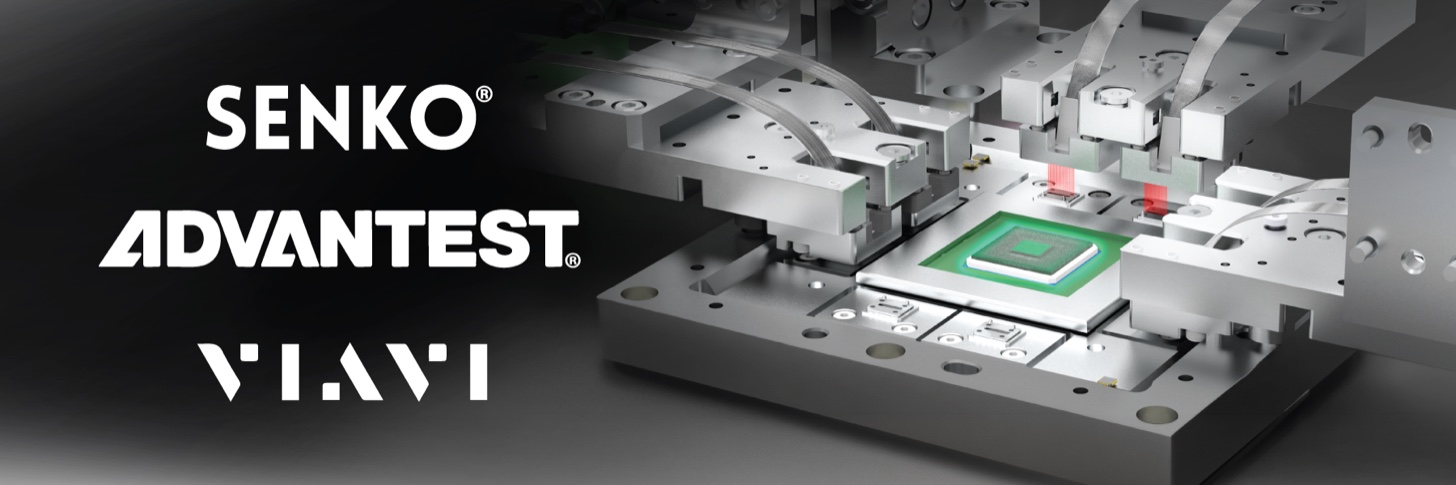
图1|三方联合演示主视觉:Advantest 自动化测试环境 + SENKO 可拆卸光连接 + VIAVI 高速光子测试能力(图片版权归 SENKO Advanced Components 所有)
Enabling the Next Era of AI Infrastructure
As AI data centers transition from compute-bound to connectivity-bound architectures, the demand for high-speed optical interconnects is surging. The industry is rapidly moving toward Co-Packaged Optics (CPO) to overcome the physical limits of copper. SENKO, Advantest and VIAVI are addressing these integration challenges by delivering an automated, highly repeatable testing platform.
At the center of the demonstration is Advantest’s automated test environment, integrating SENKO’s detachable optical connectivity and VIAVI’s high-speed photonic test capabilities to simulate high-volume CPO manufacturing conditions.
“The transition to co-packaged optics is redefining how the industry approaches network scalability, power efficiency and AI infrastructure,” said Dr. Ryan Vallance, Vice President of Emerging Technologies Group at SENKO. “While photonic technologies have matured rapidly, scalable manufacturing and testing remain among the most significant barriers to widespread deployment.”
The Challenge of CPO Testing
SENKO, Advantest and VIAVI will be demonstrating this pioneering collaboration at the European Conference on Optical Communication (ECOC) in Malaga, Spain, in September 2026.
One of the key requirements for CPO final testing is the ability to transmit 200 Gbps per lane through a detachable optical connector. Traditionally, high-speed optical engines have relied on permanently attached pigtails, making detachable connectivity at these data rates challenging.
Using VIAVI’s photonic and 1.6 Tbps transceiver test platform as a representative optical engine, the solution demonstrates BER (Bit Error Rate) testing of 200 Gbps signals through a detachable connector interface.
“The challenge is no longer proving photonic performance in the lab, but validating it repeatedly in a production environment at AI optics scale,” said Matt Adams, Director, Lab and Production, Product Line Management, VIAVI Solutions. “As volumes increase, consistent measurement and test methodologies become increasingly crucial to ensure quality, reliability and manufacturing efficiency.”
Moreover, in actual manufacturing environments, production volumes may reach tens of thousands of units per month. For example, a test flow operating at 40 UPH (Unit Per Hour) corresponds to more than 28,000 (40 units x 24 hours x 30 days) units per month. These production conditions place significantly greater demands on connector durability and reliability than those encountered with conventional detachable FAUs.
To address this challenge, Advantest has developed and deployed a simulated CPO production test environment designed to evaluate automated photonic test workflows at manufacturing scale. The platform incorporates SENKO’s SAM-T (SENKO Alignment Master-Testing),a calibrated master jumper system engineered for the durability, repeatability, and accuracy required in high-volume manufacturing (HVM) environments. The platform is designed to evaluate automated test workflows, helping demonstrate the throughput and scalability required for next-generation photonic device production.
“As photonic and semiconductor integration become increasingly critical to AI infrastructure, automated and scalable testing solutions are essential to commercial success,” said Ira Leventhal, Vice President of Research & Venture, Advantest. “Our work with SENKO brings together advanced optical connectivity solutions and HVM-ready, high-performance automated test capabilities, enabling customers to accelerate the path from development to production.”
Breakthrough Durability and Throughput
The collaboration centers on SENKO’s innovative detachable interface, SEAT™ receptacle and the SAM-T (SENKO Alignment Master-Testing) HVM test connector. Manufactured from ultra-durable tungsten carbide, the test connector provides the optical interface used to couple light in and out of the PIC, while delivering the durability required for repeated mating cycles in high-volume manufacturing environments.
Key features of this technology include:
- Extreme Repeatability: The tungsten carbide construction allows the connector to be attached and detached thousands of times without degradation of the material or optical signal.
- Elastic Averaging: The SAM-T (SENKO Alignment Master-Testing) incorporates the same Elastic Averaging features that will be present in future Fiber Array Units (FAUs) used in final CPO switch integration.
- Throughput Enhancement: The SAM-T (SENKO Alignment Master-Testing) can be ganged to test multiple optical engines simultaneously, enabling mass-testing to be achieved much faster than current single-connector solutions.
- Reduced Downtime: The robustness of the connector allows machines to operate for many thousands of cycles without the need for frequent equipment replacement or maintenance-related downtime.
As co-packaged optics moves toward broader deployment, industry collaboration is becoming increasingly important to establish practical approaches for manufacturing, testing, and serviceability. Through their combined expertise, SENKO, VIAVI, and Advantest are contributing to the ecosystem needed to support scalable CPO adoption.
About SENKO Advanced Components, Inc.
SENKO Advanced Components, Inc. is a wholly owned subsidiary of SENKO Advance Co., Ltd., headquartered in Yokkaichi, Japan. With 16 locations worldwide and extensive design and manufacturing capabilities, SENKO is recognized as a global leader in passive fiber optic interconnects and optical components. SENKO has deployed over 1 billion connectors, holds more than 500 patents, and continues to pioneer next-generation connectivity solutions for the Data Center, Telco, and Wireless markets.
To accelerate innovation in emerging applications such as Co-Packaged Optics, optical alignment technologies, and AI-enabling interconnects, SENKO has established the Emerging Technologies Group (ETG), a specialized division focused on developing advanced photonic solutions that address the future of high-performance networking.
For more information, visit https://www.senko.com
About Advantest
Advantest (TSE Prime: 6857) is the leading manufacturer of automatic test and measurement equipment used in the design and production of semiconductor devices such as high-performance compute (HPC), artificial intelligence (AI), automotive, industrial and consumer applications. Founded in Tokyo in 1954, Advantest is a global company with facilities around the world and an international commitment to sustainable practices and social responsibility. Its leading-edge systems and products are integrated into the most advanced semiconductor production lines in the world. The company offers a broad portfolio of test solutions that span the semiconductor value chain, developing advanced test solutions for wafer sort and final test, design verification and silicon validation, and system-level test solutions, as well as test handlers, device interfaces and scanning electron microscopes essential to photomask manufacturing. Advantest also offers data analytics solutions designed to improve semiconductor yield. More information is available at https://www.advantest.com/en/.
About VIAVI
VIAVI (NASDAQ: VIAV) is a global leader in test and measurement and optical technologies. Our test and measurement and resilient position, navigation and timing solutions enable and secure critical infrastructure ranging from data center ecosystems and communication networks to military, aerospace, railway and first responder communications. In addition, we develop and advance technologies used in high-volume optical applications across anti-counterfeiting, consumer electronics, aerospace, industrial and automotive end markets.
Learn more about VIAVI at https://www.viavisolutions.com.
第二部分:解析(中文深度解读)
一、核心论点摘要
这篇新闻稿真正的信号不在「三家合作」本身,而在它把 CPO 的量产瓶颈明确定位到了测试接口上:
| 维度 | 内容 |
|---|---|
| 瓶颈 | CPO 终测要求 200 Gbps/lane 通过可拆卸光连接器传 BER 测试;传统高速光引擎用永久尾纤(pigtail),在这个速率下做可拆卸连接极难 |
| 分工 | SENKO = 可拆卸光接口(SEAT™ 插座 + SAM-T 碳化钨测试连接器);Advantest = 自动化 HVM 测试环境(ATE);VIAVI = 1.6 Tbps 光引擎/收发器测试平台 + BER |
| 关键指标 | 碳化钨连接器可反复插拔 数千次不劣化;SAM-T 可 ganged 并联同时测多个光引擎;40 UPH ≈ 每月 28,000+ 台 |
| 场合 | ECOC 2026(2026 年 9 月,西班牙 Malaga)现场演示,属 simulated production test environment(模拟产线测试环境) |
一句话概括:CPO 的问题已经不是「实验室里能不能做出光子性能」,而是「在 AI 光学的规模上,能不能反复、可追溯地验证它」。
二、关键概念解读
1. 为什么「可拆卸」在 CPO 里是道坎
传统可插拔光模块(QSFP/OSFP)之所以好测,是因为模块本身就是可插拔的——测试夹具插的是笼子(cage),激光器在模块里,坏了换模块。
CPO 把光引擎和交换 ASIC 封装到同一基板上,光引擎不再是独立的现场可更换单元。如果光引擎仍然拖一根永久熔接的尾纤(pigtail),那么尾纤一旦损伤,报废的就是整颗昂贵的 CPO 封装——这是 OEM 无法接受的。于是产业被迫要求:在 200 Gbps/lane 的速率下,光接口仍然要可拆卸(detachable)以实现 serviceability。
但可拆卸意味着每次插拔都要重新对准。200 Gbps/lane(PAM4,约 106 GBd)下单模光纤的模场直径只有 ~9 µm,亚微米级的对准偏差就会直接吃掉链路预算、恶化插损与回损。「可拆卸」与「高速率」在这里是正面对撞的,这就是标题里那个 hidden bottleneck。
2. Elastic Averaging:测试接口与量产接口必须同源
这是全文技术含量最高、也最容易被跳过的一条:
SAM-T 采用了与未来 CPO 交换机最终集成所用 FAU(Fiber Array Unit)相同的 Elastic Averaging 特征。
Elastic Averaging(弹性平均)是精密连接器的经典手法:不做单个高精度定位销,而是做多个可微量弹性变形的定位特征,插合时各自发生微小形变,加工误差在统计上被平均掉,从而实现远超单件加工精度的重复定位精度。
关键在于「同源」二字。如果测试用的 master jumper 与最终产品用的 FAU 对准机理不同,那么测出来的结果就只是「这个测试夹具下的结果」,无法外推到真实交换机里的光性能——测量就没有可追溯性。SENKO 刻意让 SAM-T 与未来 FAU 共用同一套弹性平均特征,等于把 golden reference(校准过的标准跳线) 的概念引入了 CPO 测试,这正是 HVM 的前提。
3. 40 UPH 这笔账:把连接器寿命变成 OPEX 问题
原文给的算术很直白:40 units × 24 hours × 30 days = 28,800,即「每月 2.8 万台以上」。
这个数字的意义是把问题从技术指标翻译成产线经济账:
- 假设连接器寿命只有 500 次插拔 → 28,800 台/月意味着每月要更换约 58 只测试连接器,还得重新校准;
- 若寿命是 5,000 次 → 每月不到 6 只,且校准停机大幅减少;
- 每只 master jumper 都不是标准耗材,而是校准过的量测基准,更换成本 = 器件成本 + 校准工时 + 产线停机。
所以「碳化钨(tungsten carbide)+ 数千次插拔不劣化」不是材料炫技,而是直接决定 CPO 产线的单台测试成本(test cost per unit)。这也解释了为什么 Reduced Downtime 会被单列成一项卖点。
4. 从 lab proof 到 production validation
VIAVI 的 Matt Adams 那句引用是全文题眼,值得单独拎出来:
The challenge is no longer proving photonic performance in the lab, but validating it repeatedly in a production environment at AI optics scale.
这句话划出了 CPO 产业化的阶段线:实验室验证阶段已经结束,产线验证阶段刚开始。前一阶段的竞争指标是插损、带宽、功耗;后一阶段的竞争指标是测量一致性(consistent measurement methodology)、吞吐(UPH)、良率与可追溯性——这恰好是 ATE 厂商(Advantest)和仪表厂商(VIAVI)的主场。
三、三层拆解
| 层级 | 问题 | 本次方案 | 供应方 |
|---|---|---|---|
| 器件/接口层 | 200 Gbps/lane 下可拆卸连接的对准重复性、插拔寿命 | SEAT™ 插座 + 碳化钨 SAM-T 测试连接器 + Elastic Averaging | SENKO |
| 测试系统层 | 光引擎终测的激励、BER 判定与自动化流程 | simulated CPO production test environment(自动化测试工作流)+ 1.6 Tbps 收发器测试平台与 BER 测试 | Advantest + VIAVI |
| 产线运营层 | 每月数万台的吞吐、停机时间、校准追溯 | ganged 并行测试多光引擎;数千次插拔免更换;calibrated master jumper 体系 | SENKO + Advantest |
四、技术趋势判断
CPO 生态正在从「两方」扩展到「三方联盟」。 早期 CPO 叙事是「交换机厂商(Broadcom/NVIDIA)+ 光引擎厂商」的两方游戏。现在连接器厂(SENKO)、ATE 厂(Advantest)、仪表厂(VIAVI)同时进场,且是以联合演示的形式——这是技术从「架构验证」走向「制造验证」的典型信号。
测试接口的标准化会成为新的卡位战。 谁的 master connector 成为事实上的 golden reference,谁就锁定了后续 CPO 产线的量测基准。SENKO 的策略很清晰:把自身在 SN®/SN-MT/CS 等 VSFF 连接器上的存量优势,通过 SEAT™ + SAM-T 延伸到 CPO。
与 NPO 路线的分野在测试侧被放大。 NPO(近封装光学)保留了可插拔模块形态,因此能沿用成熟的可插拔测试生态;CPO 必须重建一整套可拆卸测试接口。这部分「重建成本」正是 CPO 相对 NPO 的隐性劣势,也是 SENKO 这类厂商的增量空间。可对照本站 NPO 光电链路实验室 与 Optical Illusion: CPO is Dead, Long Live NPO 中关于两条路线内容量的讨论。
「40 UPH / 每月 2.8 万台」是目前公开信息里少见的 CPO 产线吞吐锚点。 若后续有厂商披露实际 CPO 产线的 UPH 与测试成本,这个数字是很好的对比基准。
五、风险提示(务必区分「演示」与「量产」)
- 这是模拟产线环境(simulated production test environment)与 ECOC 现场演示,不是已量产交付的验证结果。 原文用词是 demonstrate / simulate / designed to evaluate,没有给出实际客户产线的运行数据。
- 「thousands of times」没有具体数字,也没有插损/回损随插拔次数的漂移曲线。 这是判断方案成熟度的核心数据,目前缺失。
- 40 UPH 是设定的产线节奏假设,不是实测吞吐。 用它反推测试成本时要注意这一点。
- 三家是互补供应商联盟,不是中立第三方。 所有指标均由参与方自行发布,未经独立机构验证;读的时候请把它当作厂商联合声明,而非测试报告。
- SEAT™ / SAM-T 是 SENKO 专有方案。 能否成为事实标准,取决于交换机与 OEM 厂商的采纳,而非 SENKO 一侧能决定。
小结:CPO 的故事正在换章节——从「能不能做出来」转向「能不能在每月几万台的节奏上,用同一套可追溯的量测基准反复验证」。这篇文章给出的答案还很初步(模拟环境 + 演示),但它第一次把瓶颈、分工和量化锚点(200 Gbps/lane、40 UPH、数千次插拔)摊在桌面上,值得作为后续跟踪 CPO 产业化的基线。